


Recruitment Intelligence: The Missing Layer in Talent Acquisition
Updated On:
February 20, 2026

Why Hiring Still Feels Like a Gamble
Recruiting has always been the businessequivalent of playing poker with half the cards face down. Companies spend billions on technology, tools, and branding campaigns, yet the nagging sense remains that hiring is more guesswork than science. Ask a CEO, and they’ll say talent is the number-one driver of competitive advantage. Ask a recruiter, and they’ll talk about drowning in résumés, juggling requisitions, and relying on inconsistent hiring managers. Ask candidates, and they’ll tell you about ghosting, repetitive interviews, and processes that feel arbitrary at best.
Over the decades, recruiting has evolved through phases of efficiency. We’ve gone from classified ads to job boards, from spreadsheets to applicant tracking systems (ATS), and from phone screenings to AI chatbots. From job boards to chatbots, AI in recruitment has promised efficiency — but not always understanding. Each wave brought hope for clarity, yet once the initial shine faded, the same complaints resurfaced: too much noise and too little signal.
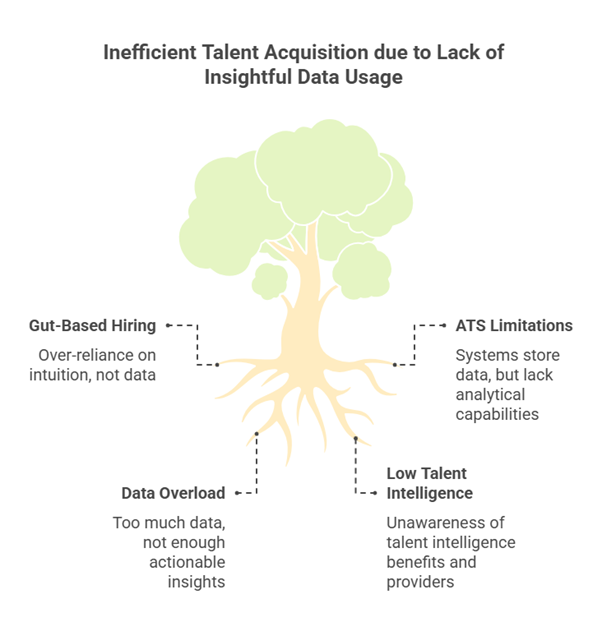
The core problem is not that recruiting lacks data. Quite the opposite. Talent acquisition generates more data today than at any point in history. The problem is that we’ve been automating activity without adding intelligence. We can move candidates through pipelines faster, but we’re not making better decisions about who will succeed and stay.
What’s missing is a connective layer — a system that turns data into decisions, signals into clarity, and hiring into a repeatable, evidence-driven discipline. That missing layer is Recruitment Intelligence.
This article defines recruitment intelligence, traces its history, explores its technological and ethical foundations, and shows how it can transform hiring from transactional chaos into strategic foresight.
A Short History: From Gut Feel to Data Exhaust
Recruitment intelligence may feel like a new term, but its roots go back decades. The story of hiring is really the story of attempts to impose order on uncertainty.
Project Talent: The First Experiment in Scale
In 1960, the U.S. government launched Project Talent, one of the largest longitudinal studies ever attempted. Over 440,000 high school students were assessed on aptitude, personality, and socio-demographic factors, with researchers hoping to predict educational and career outcomes. It wasn’t flawless, but it proved that systematic data collection could illuminate patterns in human potential. It set the stage for everything that followed.
The War for Talent
By 1997, McKinsey had declared a new era: the “War for Talent.” Their research, later expanded in a 2001 book, argued that talent was the decisive factor in competitive advantage. Companies, they warned, would rise or fall on their ability to attract and retain high performers.
The message was loud, but the methods remained quiet. Recruiting still leaned heavily on résumés, references, and gut feeling. The rhetoric was about strategy; the practice was still largely guesswork.
ATS and the Digital Filing Cabinet
The late 1990s and early 2000s brought Applicant Tracking Systems (ATS) and Electronic Human Resource Management (E-HRM). These digitized applications created compliance records and made tracking possible. For the first time, recruiters could see where every candidate sat in the pipeline.
But visibility wasn’t insight. ATS systems were digital filing cabinets — good at storage and workflow, bad at telling you whether a candidate would thrive.
People Analytics and the Early Data Age
By the 2010s, people analytics entered HR vocabulary. Companies started building dashboards to track turnover, performance, and even early predictors of attrition. Oracle’s 2021 survey showed a third of organizations using predictive analytics in hiring.
Meanwhile, platforms like LinkedIn began using deep learning to improve search. Instead of literal keyword matches, their algorithms could infer skills and adjacent roles, surfacing candidates who might otherwise be overlooked.
But even as tools grew smarter, adoption lagged. Most TA teams deployed automation — résumé screeners, scheduling bots, and communication tools — without embedding intelligence. The result? A flood of data exhaust. Reports piled up. Metrics multiplied. But actionable clarity remained elusive.
(Read more → AI Recruiting Tools: Why You Should Expect More)
Today: Acceleration Without Understanding
Adoption of AI in recruitment skyrocketed in 2023–24, rising from 26% to 53% in a single year. Common uses include job description automation, candidate communications, résumé screening, and scheduling. Yet Aptitude Research found only 28% of companies could define “talent intelligence,” and fewer could name a provider. Adoption of AI in recruitment surged in 2023–24, rising from 26% to 53% (HR.com), yet most companies still lack a unifying framework to interpret what the data means.
We’ve built speed and volume. What’s missing is clarity. That’s the gap recruitment intelligence fills.
What Is Recruitment Intelligence?
Recruitment intelligence is not a point solution or a shiny dashboard. It’s a discipline: the integration of data, context, and predictive insight across the hiring lifecycle.
At its core, recruitment intelligence brings together four components:
- Signal capture — turning the noise of hiring (résumés, interviews, assessments) into structured data.
- Contextual integration — connecting internal data (ATS, HRIS, performance) with external signals (labor markets, skills maps, competitor activity).
- Predictive modeling — applying machine learning to forecast performance, tenure, cultural fit, and attrition risk.
- Human oversight — ensuring recruiters and managers interpret, challenge, and contextualize outputs rather than surrendering decisions to algorithms.
Josh Bersin frames talent intelligence as the merger of people analytics, sourcing data, and workforce planning. Recruitment intelligence is its applied cousin: the hiring-specific operating layer that turns activity into clarity.
Think of recruiting tools as apps — job boards, assessments, and ATS workflows. Recruitment intelligence is the operating system underneath. Without it, apps don’t talk to each other, signals get lost, and outcomes remain unpredictable.
Why now? The Pressures Driving Recruitment Intelligence
Several converging forces make this discipline urgent.
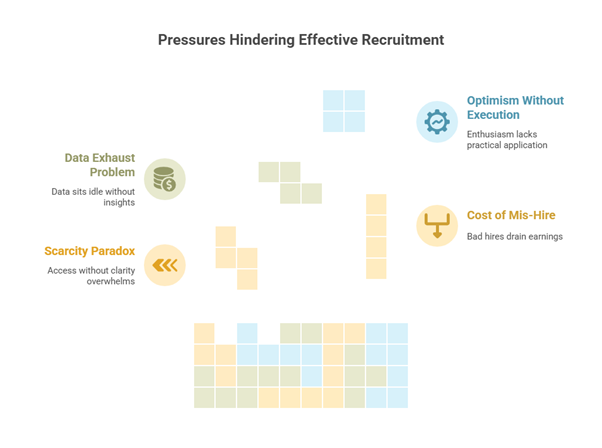
The Scarcity Paradox
Remote work theoretically expanded global pools. Yet Gartner reports that 64% of HR leaders still cite shortages as their top barrier. Why? Because access without clarity is overwhelming. More résumés don’t equal better choices. Intelligence is the filter.
The Cost of Mis-Hire
The U.S. Department of Labor estimates a bad hire costs up to 30% of first-year earnings. For executives and technical hires, losses climb into millions. Case studies show the payoff
The Data Exhaust Problem
Most firms already collect mountains of recruiting data. But Aptitude Research found only 25% of companies have a clear definition of “quality of hire.” Without intelligence, data sits idle.
Optimism Without Execution
LinkedIn’s 2024 report found 62% of TA professionals optimistic about AI, but only 27% experimenting with generative tools. Recruitment intelligence bridges the enthusiasm-execution gap.
Core Components in Detail
Signal Capture
Every hiring interaction generates signals: résumé keywords, coding test results, interview impressions, and even response times. Without structure, these evaporate into anecdotes. Recruitment intelligence enforces structured capture — rubrics, scoring templates, and shared taxonomies — making feedback comparable across candidates.
Contextual Integration
A résumé score or assessment alone is trivia. Intelligence connects disparate data into context. A candidate’s coding test is mapped to team collaboration scores, performance of similar past hires, and market benchmarks. The result is not just “good coder” but “likely to succeed in this environment.”
Predictive Modeling
Machine learning is where raw signals turn into genuine foresight. Instead of relying on intuition or outdated heuristics, modern models analyze patterns across résumés, assessments, interview feedback, and historical performance data to predict which candidates are most likely to succeed, grow, and stay.
Advanced techniques such as Random Forests and Neural Networks have proven especially effective in recruitment contexts, consistently delivering stronger, more reliable predictions than traditional approaches. The real breakthrough comes from continuous learning: every new hire contributes fresh outcome data—performance reviews, ramp-up time, retention—that feeds back into the system, steadily sharpening its accuracy over time.
When organizations connect multiple data streams (ATS, HRIS, skills assessments, internal mobility records, and external benchmarks), the result is a far richer, more nuanced understanding of talent. Leaders who adopt these predictive capabilities move from reactive hiring to strategic foresight, identifying high-potential candidates earlier and reducing costly mis-hires.
The trajectory is clear: predictive analytics is rapidly becoming a standard layer in talent acquisition, with industry analysts forecasting that within the next few years, the majority of hiring processes will rely on data-driven models to inform decisions. This isn’t a replacement for human judgment—it’s the intelligence layer that finally lets judgment operate at its best.
Human-in-the-Loop Oversight
AI is powerful but imperfect. A University of Melbourne study (2025) found AI interview systems mis-transcribed non-native accents with error rates of 12–22%, unfairly penalizing candidates. Recruitment intelligence embeds human checkpoints, ensuring oversight and fairness.
Feedback Loops
Recruiting doesn’t end at offer acceptance. True intelligence loops outcomes back in: retention data, performance ratings, and cultural alignment. Every hire becomes a data point, refining the system’s predictive power.
Technology Foundations: From Models to Workforce Sciences
Recruitment intelligence is more than buzz; it rests on serious technical foundations.
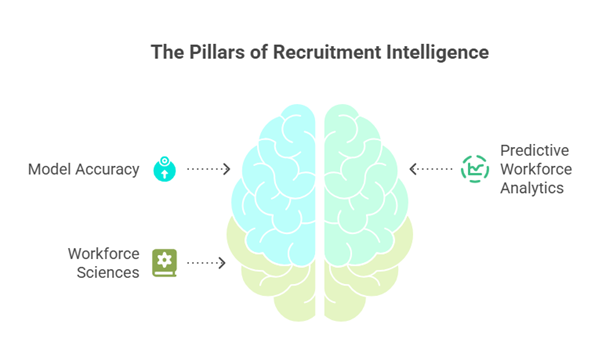
Model Accuracy Matters
A 2024 comparative study found RandomForest and neural network models consistently outperformed SVMs and logistic regression in recruitment predictions. For enterprises, the choice of model affects not just accuracy but trust in the system.
Predictive Workforce Analytics
Organizations have moved from descriptive reporting (“time-to-hire”) to predictive workforce analytics. By integrating HRIS, ATS, performance, and external benchmarks, companies forecast attrition and hiring needs with 35% greater accuracy.
Workforce Sciences: The Academic Backbone
Recruitment intelligence belongs to the emerging field of workforce sciences, which blends labor economics, industrial-organizational psychology, and machine learning. Its goal: measure and optimize workforce flows. Framed this way, recruiting shifts from transactional execution to strategic system design.
Ethics, Fairness, and Candidate Trust
Without ethics, recruitment intelligence becomes a liability.
Bias Amplification
Algorithms replicate history. If historical data reflects bias, models reinforce it. Without audits, “culture fit” becomes a code word for sameness. Academic reviews recommend fairness metrics, bias detection tools, and transparency protocols as standard practice.
Candidate Trust
A European Management Journal study (2025) found candidates view AI as efficient, but skepticism rises when personal or social media data is used. Engineers were particularly cautious. Transparency — explaining what data is used and how—is critical.
Case Studies in Failure
- Rikunabi (Japan, 2019): Student data was sold without consent, triggering national backlash.
- Melbourne Study (2025): AI interview tools mis-transcribed non-native accents, penalizing qualified candidates.
Both underscore the cost of careless implementation.
Diversity and Inclusion Challenges
A 2024 co-design workshop showed D&I awareness improves with AI adoption, but operationalizing fairness is difficult. Recruitment intelligence must embed bias monitoring and fairness frameworks into its design.
Strategic Applications
Recruitment intelligence isn’t theoretical; it changes outcomes.
Improving Quality of Hire
Only 25% of firms define quality of hire. Intelligence ties it to measurable outcomes: ramp time, performance scores, and tenure.
Reducing Attrition
With 44% of workers’ core skill sets set to change by 2027 (WEF), intelligence surfaces adjacent skills and growth potential, making workforces more resilient.
Diversity at Scale
By structuring evaluation and auditing algorithms, recruitment intelligence makes DEI measurable and enforceable.
Competitive Advantage
Aptitude Research found adopters of talent intelligence achieved 2–3x improvements in candidate experience, time-to-fill, and quality of hire. Recruitment intelligence reframes TA as a strategic lever, not a cost center.

Challenges and Barriers
Adoption isn’t easy.
- Integration: 47% of companies cite system integration as the top barrier (Mercer, 2023).
- Skills Gap: Recruiters are rarely trained as analysts. Without upskilling, systems become black boxes.
- Cultural Resistance: Hiring managers prefer intuition over structured rubrics.
- Governance Burden: Audits, compliance, and explainability add overhead that leaders must plan for.
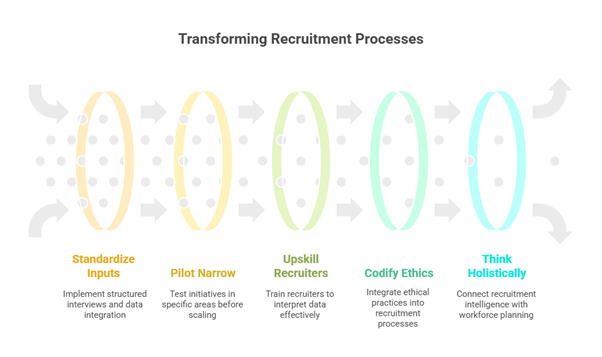
A Roadmap for Leaders
- Start with Pain Points. Anchor initiatives in mis-hire costs, retention, or DEI, not in shiny tech.
- Standardize Inputs. Enforce structured interviews and integrated data. Garbage in, garbage out.
- Pilot Narrow. Test intelligence in sourcing optimization or attrition prediction before scaling.
- Upskill Recruiters. Tomorrow’s recruiters are interpreters of signals, not just pipeline managers.
- Codify Ethics. Build audits, transparency, and oversight into the process, not as afterthoughts.
- Think Holistically. Link recruitment intelligence to workforce planning, mobility, and development.
Looking Ahead: Recruitment Intelligence as Discipline
Recruitment intelligence is more than a toolset. It’s an emerging discipline, rooted in workforce sciences and predictive analytics.
For decades, recruiters navigated with résumés and gut feel — the equivalent of sailors steering by stars. Recruitment intelligence is radar. It doesn’t replace judgment, but it reveals hazards, forecasts storms, and highlights opportunities.
Companies that embed it will not just hire faster. They will anticipate skills disruption, protect fairness, and turn hiring into a competitive weapon. Those that don’t will continue running faster on the same treadmill — more dashboards, more résumés, but no clearer outcomes.
FAQs
Q1: How has recruitment evolved into recruitment intelligence?
Recruitment has matured from manual processes into a discipline powered by recruitment intelligence, where data, AI, and human judgment work together to make hiring smarter and more consistent.
Q2: What role does AI in recruitment play in modern job matching systems?
AI in recruitment enhances human decision-making by handling repetitive tasks, surfacing qualified talent faster, and ensuring every candidate is evaluated with greater accuracy and fairness.
Q3: How is talent intelligence connected to recruitment intelligence?
Talent intelligence maps the broader workforce landscape, while recruitment intelligence applies those insights in real time to help organizations hire with precision, clarity, and confidence.
Q4: How do data-driven recruitment practices improve hiring quality?
By grounding decisions in measurable outcomes, data-driven recruitment reduces guesswork, improves quality of hire, and helps teams build high-performing, future-ready workforces.
Q5: What ethical safeguards support workforce analytics and AI-led hiring?
Modern workforce analytics platforms prioritize transparency, fairness, and human oversight—ensuring technology strengthens trust and inclusion instead of replacing it.
Conclusion: Filling the Missing Layer
Recruiting has long chased efficiency — faster postings, quicker pipelines, and cheaper sourcing. But efficiency without intelligence is a faster path to mistakes.
Recruitment intelligence fills the missing layer. It empowers recruiters instead of replacing them. It sharpens human judgment rather than dulling it. It doesn’t just predict — it learns, iterates, and evolves.
The organizations that use AI in recruitment as part of a broader intelligence strategy — not just automation — will lead the next decade.The future of hiring won’t be owned by those who move fastest. It will belong to those who see clearest. Recruitment intelligence is how we start seeing.





Stop tracking hiring.
Start running it
We’re onboarding early teams ready to experience AI recruiting that’s faster, smarter, and easier to manage. No fees. No commitments. Just real usage and real feedback.


