


AI Job Matching: How Modern Systems Understand Fit
Updated On:
February 20, 2026

Job Matching in the Age of Agentic AI
Job matching has always been about more than just filling roles. From early aptitude tests in the 1900s to today’s AI Job matching systems, organizations have sought ways to connect people with work they can thrive in. Traditional ATS reduced resumes to keywords, missing nuance. AI now reads context, models person-job fit, and even suggests upskilling. The future is agentic AI: systems that don’t just filter candidates but act like recruiters, proactively sourcing, scheduling, and reasoning about fit.
(Read more about how the recruitment process evolved → The Evolution of Recruitment Process.)
Why This Matters Now
Recruiting feels like a paradox in 2025. On one hand, unemployment is low and global talent shortages persist across engineering, data science, and specialized roles. On the other, many candidates struggle to find opportunities that recognize their potential. Companies complain about “no good candidates,” while jobseekers lament endless applications disappearing into black holes.
The culprit isn’t just supply and demand. It’s the matching function itself — the machinery that connects people to jobs. For decades, that machinery was built on brittle keyword filters. If your resume didn’t match the right buzzwords, you didn’t exist.
But hiring today demands more. A role like “AI Product Manager” might require a blend of software engineering, business strategy, and ethics — none of which show up neatly in a keyword search. Recruiters need systems that understand nuance. Candidates need systems that see potential. Organizations need systems that can predict not just who can do the job, but who will stay, grow, and add value.
This is why AI job matching matters now. It represents a leap from literal filters to contextual intelligence. From static searches to adaptive, learning systems. From passive record-keeping to active recruitment agents.
And the question for every talent leader is this: are you ready to steward that leap?
(To understand how AI goes beyond surface-level skills and analyzes deeper capabilities, read more in our deep dive → Rethinking Tech Hiring.)
A Century in the Making: The Evolution of Recruitment Process
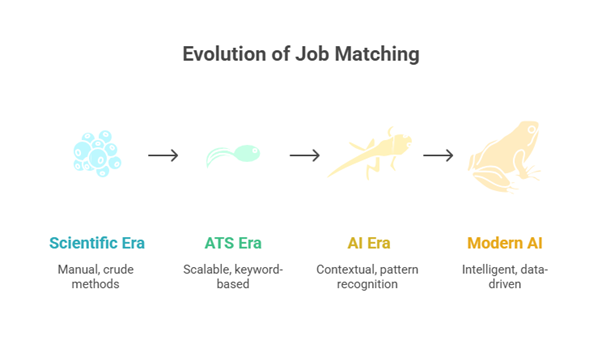
The Scientific Era (1900s–1950s)
The pursuit of fit began with clipboards, stopwatches, and psychological tests.
In 1911, Frederick W. Taylor published The Principles of Scientific Management. He argued that work could be broken into measurable motions and workers selected for efficiency. In practice, this meant timing how long it took someone to shovel coal or assemble parts, then standardizing the process. Taylorism wasn’t humane, but it was the first attempt to treat hiring as a science.
Industrial psychologists soon followed. In the 1920s and 1930s, figures like Hugo Münsterberg and Walter Dill Scott began designing aptitude and temperament tests. Employers wanted to know: did this clerk have the memory for book keeping? Did this assembly-line worker have the patience for repetition?
These early methods were crude, but they shared a bold idea: fit could be quantified. That idea would echo across the next century.
The ATS Era (1980s–1990s)
Fast-forward to the computer age. By the 1980s, resumes arrived by the thousands. Recruiters needed help. Enter the Applicant Tracking System (ATS).
The ATS was essentially a database with search. You could load in resumes, tag them, and query for keywords. If a hiring manager asked for “project management,” you typed the phrase and got a list.
This was revolutionary for scale. Companies could now process tens of thousands of applications. But nuance was lost. If the resume said “program management,” the candidate vanished. If it said “agile sprint leadership,” the system might miss the equivalence.
ATS systems treated words like exact puzzle pieces. If they didn’t fit perfectly, they didn’t count.
The AI Era (2000s–Today)
The 2000s brought new tools: natural language processing, machine learning, embeddings. These didn’t just count words. They interpreted them.
A recruiter searching for “React developer” would also see “frontend engineer.” A system parsing “built churn prediction models in TensorFlow” could infer skills in machine learning, Python, and analytics.
This shift — from literal to contextual — marked the start of modern AI job matching. Instead of searching for puzzle pieces, systems began recognizing patterns, meanings, and equivalences.
And as data exploded — billions of resumes, millions of job postings — AI models learned faster than any human recruiter ever could.
The Psychology of Fit: Why It Matters
Decades before AI, psychologists studied why some people thrive at work and others flounder. Their findings remain the backbone of modern hiring theory.
- Person–Job Fit: alignment between skills and job tasks.
- Person–Organization Fit: alignment between individual values and company culture.
- Person–Group Fit: alignment with team dynamics and leadership style.
Edwards’ 1991 review showed that poor fit led to stress, absenteeism, and turnover. Kristof-Brown’s 2005 meta-analysis demonstrated strong links between fit and outcomes like satisfaction and performance.
In other words: fit matters. A technically skilled employee misaligned with company culture won’t last. A team player placed in a cutthroat environment may disengage.
Modern AI operationalizes this theory. Algorithms now model not just skills but signals of retention, cultural compatibility, and adaptability. They transform intuition into measurable features.
For HR leaders, this is both an opportunity and a caution. AI can help scale “gut feel” into structured data. But if the wrong signals are used — say, modeling “culture fit” as “same background as current employees” — bias seeps in.
How AI Understands Fit: Under the Hood
AI systems for job matching use multiple building blocks. Let’s unpack them.
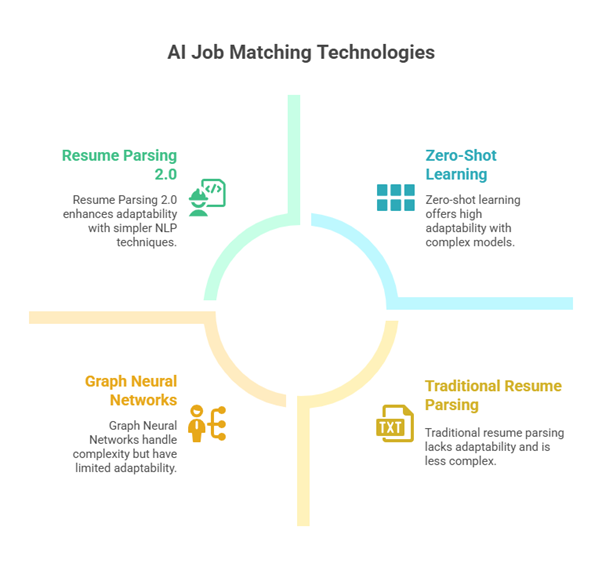
Resume Parsing 2.0
Traditional parsers pulled out names, dates, and job titles. Modern parsers, powered by NLP, extract skills, achievements, and inferred capabilities.
Example:
Resume line — “Led churn prediction project using TensorFlow.”
Parser output — Skills: machine learning, Python, TensorFlow, predictive modeling, data analytics.
This transforms raw text into structure dsignals for algorithms.
Embeddings and Semantic Matching
Embeddings are the secret sauce. They translate text into mathematical vectors that capture meaning.
Think of it as plotting words on a map. “React developer” sits close to “frontend engineer” but far from “coffee barista.” Resume2Vec and CareerBERT are leading examples.
CareerBERT, fine-tuned on labor taxonomies, understands domain-specific context. A general model might confuse “pitcher” in sports vs. work. A career model knows which meaning belongs in a resume.
Graph Neural Networks
At scale, graphs matter. LinkedIn’s LinkSAGE treats its billions of members, jobs, and skills as nodes in a graph. Relationships — shared skills, connections, career transitions — form edges.
Graph neural networks analyze these structures, solving cold-start problems. If a new role “AI Ethicist” appears, the system can recommend candidates based on adjacent skills and paths, even if the title is new.
Contrastive & Zero-Shot Learning
Real-world data is messy. Many resumes are incomplete. New roles emerge constantly.
Contrastive models like ConFit learn by comparing pairs, improving performance when data is sparse. Zero-shot models, like those tested by Kurek et al. (2024), can rank jobs for resumes without retraining. That means they can adapt instantly to new titles like “prompt engineer.”
For enterprises, this adaptability is crucial. Hiring moves too fast for systems that require constant retraining.
Case Studies: AI in Action
CareerBuilder
CareerBuilder deployed a two-stage embedding-based recommendation system across billions of resume-job matches. Click-through rates rose, and recruiters reported higher-quality shortlists.
The system didn’t just reduce workload. It expanded reach. Candidates with unconventional wording or cross-domain skills surfaced more often.
LinkedIn’s LinkSAGE
LinkedIn built LinkSAGE, a graph neural network model across its platform. A/B tests showed improved application rates and retention.
The key? Cold-start roles and members. Even if a candidate or job was brand new, the graph’s structure gave the system enough context to make recommendations.
World Bank Pilot
In a World Bank-supported initiative working with Poland’s public employment services, AI was used to help displaced workers (including Ukrainian refugees) transition to new roles.
Instead of matching solely on past job titles, the system analyzed transferable tasks and skills — recommending logistics roles for former factory workers or healthcare administration paths for clerical staff.
Participants reported discovering significantly broader career possibilities than traditional title-based matching would have revealed.
German IAB Study
Researchers at Germany’s IAB institute went further. Using administrative data, they trained models not just to predict placements but job quality — wages and stability.
This reframed fit: it wasn’t only about filling seats but ensuring long-term career success.
The Dark Side: Bias and Regulation
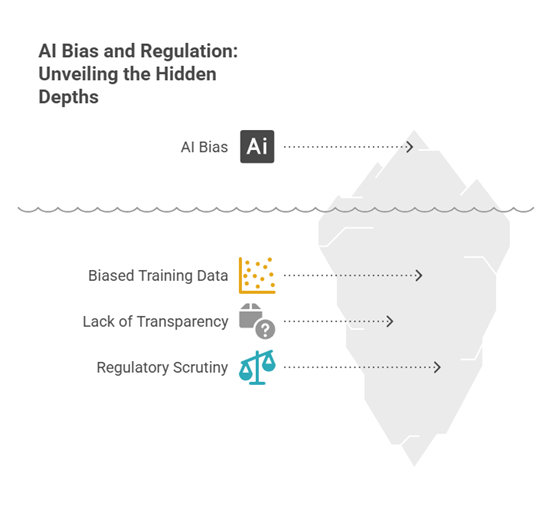
AI isn’t magic. It reflects its training data. And when that data carries bias, so do the models.
The Amazon case in 2018 is infamous. Their AI tool penalized resumes with women’s indicators. Not because the system hated women, but because it trained on past resumes — which reflected a male-dominated workforce.
Studies like Raghavan et al. (2020) found that many vendors overstated fairness. Black-box systems often couldn’t explain why they matched candidates.
Regulators are responding:
- NYC Local Law 144 requires independent bias audits of automated hiring tools.
- The EU AI Act classifies employment AI as “high-risk,” mandating transparency and compliance.
For enterprise leaders, compliance is now table stakes. The question isn’t if audits will come, but when.
The Future: Agentic AI
We’re at another turning point. If ATS were filing clerks and AI embeddings are analysts, agentic AI is the recruiter.
What Is Agentic AI?
Agentic AI refers to autonomous, pro activesystems that don’t just analyze — they act.
Instead of waiting for recruiters to run searches, agentic AI can:
- Source candidates across networks.
- Engage them with personalized outreach.
- Schedule interviews directly.
- Suggest upskilling paths for near-matches.
Real-World Pilots
- Eightfold AI positions agentic systems as the next step beyond automation.
- Workday has tested robotic recruiters that draft descriptions, schedule interviews, and orchestrate workflows.
- Decidr in Australia reported eightfold match-rate improvements with agentic recruiters.
Why It Matters
Agentic AI reframes fit. It doesn’t just say, “This candidate matches the job.” It says, “This candidate could be trained for the job — here’s how.” Or, “This candidate fits culturally — here’s why.”
It shifts recruitment from reactive filtering to proactive reasoning.
FAQs
How does AI job matching differ from traditional ATS?
Traditional ATS rely on keyword filters, while AI job matching understands context, skills, and potential — surfacing candidates who truly fit the role.
Can AI predict cultural fit or long-term performance?
Modern AI models analyze behavioral and performance patterns to estimate person–job fit and long-term alignment, without relying on biased proxies.
What are the benefits of AI in job matching and recruitment?
AI improves match accuracy, speeds up hiring, and enhances the recruitment process by learning from past outcomes to make better predictions over time.
What is agentic AI in recruitment and how does it change the process?Agentic AI goes beyond automation — it acts like a recruiter, proactively sourcing, screening, and engaging candidates while reasoning about job fit in real time.
What Leaders Should Do Now
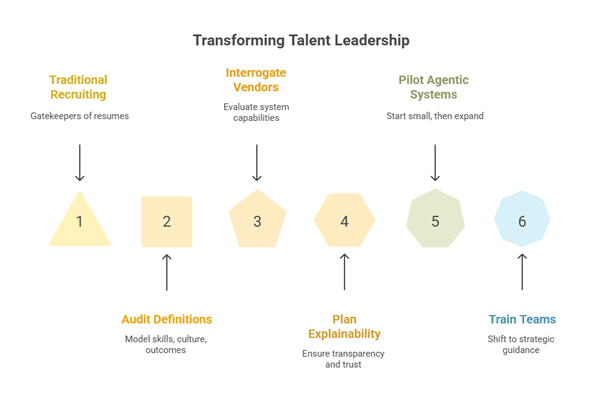
Here’s a playbook for enterprise talent leaders:
- Audit your definitions of fit. Are you modeling only skills, or also culture and long-term outcomes?
- Interrogate your vendors. Ask how their systems handle embeddings, cold starts, and bias audits.
- Plan for explainability. You’ll need transparency to comply with regulation and build trust.
- Pilot agentic systems. Start small — interview scheduling or candidate sourcing — then expand.
- Train your teams. Recruiters must shift from operators of tools to strategists who guide AI.
The future recruiter isn’t a gatekeeper of resumes. They’re a conductor of intelligence — human and machine.
Conclusion: Fit, Redefined
From Taylor’s stopwatches to today’s transformers, the dream has been constant: the right person, the right job, the right time.
ATS systems gave us scale but lost nuance. AI embeddings gave us context but stayed analytical. Agentic AI promises autonomy — systems that act, reason, and recommend.
But technology isn’t destiny. It carries the values of those who build and govern it. Leaders must ensure AI is used to widen opportunity, not narrow it. To elevate people, not reduce them to data points.
The future of recruitment isn’t about replacing judgment. It’s about scaling it responsibly.
So don’t just ask whether your systems can match resumes to jobs. Ask whether they truly understand fit — and whether you, as a leader, are ready to steward that understanding into the future of work.




Stop tracking hiring.
Start running it
We’re onboarding early teams ready to experience AI recruiting that’s faster, smarter, and easier to manage. No fees. No commitments. Just real usage and real feedback.


