


The New Hiring Stack: AI Recruiting Tools Every Modern TA Team Needs
Updated On:
February 20, 2026

Why the Hiring Stack Matters Now
The hiring landscape is no longer about “having tools.” Most large organizations already own more recruitment software than they know what to do with — ATS, CRMs, chatbots, assessment platforms, and scheduling apps. Yet ask any recruiter or hiring manager if hiring feels easier than it did ten years ago, and you’ll likely get a tired laugh.
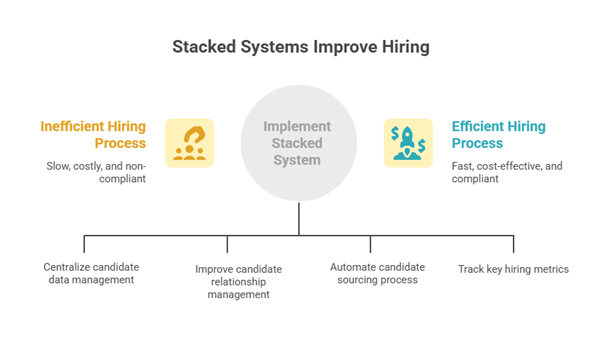
The problem isn’t the lack of tools. It’s the lack of a system.
Recruitment today is fragmented. Candidate data lives in one system, assessments in another, and interview feedback in spreadsheets. The rise of AI recruiting has changed not just how we source candidates, but how we design entire hiring systems around intelligence and automation. Compliance teams worry about bias audits; recruiters juggle logins; candidates feel like they’ve entered a bureaucratic maze.
That’s why the concept of a hiring stack matters. Just as software engineers work with a tech stack — front end, back end, databases, frameworks — modern TA teams need a hiring stack: a layered, interoperable architecture of tools, workflows, and intelligence.
Without it, you’re simply piling technology on top of problems. With it, you have an engine that learns, adapts, and scales. Deloitte’s 2025 Talent Acquisition Technology Trends calls this moment “a reset, not an upgrade.” The World Economic Forum’s Future of Jobs Report 2025 predicts HR functions, especially recruiting, as among the top three most transformed by AI by 2030.
If talent is the lifeblood of organizations, the hiring stack is the circulatory system.
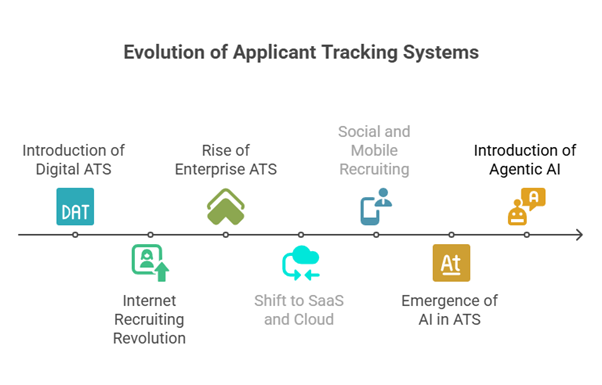
From Rolodexes to Recruitment Intelligence: A Long History
To appreciate the hiring stack’s importance, we need to zoom out. Hiring tools didn’t appear overnight; they evolved alongside work itself.
Ancient and Pre-Digital Hiring
In ancient Rome, legions recruited soldiers based on strict physical and moral standards — height, stamina, and loyalty. Recruitment was codified but manual. Medieval guilds formalized apprenticeships, setting early precedents for job descriptions. By the 19th century, staffing agencies emerged to serve factories during the Industrial Revolution. Hiring was about scale, but processes were paper-heavy and opaque.
By the mid-20th century, large companies kept resumes in filing cabinets, while recruiters worked phones and Rolodexes. Bias was invisible, compliance minimal, and candidate experience nonexistent.
1970s–1980s: Early ATS Systems
The first digital applicant tracking systems arrived in the 1970s. They were expensive, clunky, and limited to corporations with mainframes. They digitized paper processes — resume storage, application logs, and compliance records. Some systems experimented with keyword search by the 1980s, but adoption was thin.
1990s: Internet Recruiting
The 1990s were a revolution. Job boards like Monster.com and CareerBuilder allowed employers to post roles online, vastly increasing reach. But with reach came noise — hundreds of resumes per job. Recruiters were overwhelmed.
ATS vendors like Taleo, founded in 1996, stepped in. Originally called Recruitsoft, Taleo grew into the dominant enterprise ATS before Oracle acquired it in 2012. It epitomized the first real “stack layer”: a system of record to handle volume and compliance.
2000s: SaaS and the Cloud
The 2020s mark the true acceleration of AI recruiting, where automation meets autonomy and systems start reasoning about talent instead of just tracking it. Recruiters gained dashboards, workflows, and integrations. But these systems remained fundamentally administrative: compliance checkers, not decision-makers.
2010s: Social, Mobile, and Engagement
LinkedIn transformed sourcing into digital headhunting. Mobile recruiting exploded; by 2020, nearly 90% of job seekers used smartphones to search for jobs. Candidate relationship management (CRM) tools emerged, helping recruiters nurture talent pools. Engagement became a buzzword, but tools were still fragmented.
2020s: AI and Agentic Systems
AI crept in with resume parsing, skills inference, predictive analytics, and chatbots. HireVue introduced video interviews; Paradox’s Olivia automated high-volume screening and scheduling; and Codility gamified assessments. This shift reflects a broader wave of recruitment automation, where repetitive coordination gives way to continuous, intelligent orchestration.
Now, the frontier is agentic AI — autonomous systems that don’t just assist but act. iCIMS introduced fleets of sourcing and scheduling agents. SeekOut and HireEZ launched AI agents to discover and rank candidates. Workday rolled out agent management dashboards. Academic studies show multi-agent systems orchestrating interviews and scoring candidates with near-human accuracy.
Every decade has added a new layer. Today, the hiring stack is not a buzzword. It is the natural evolution of recruiting itself.
Defining the Hiring Stack
The hiring stack is the layered architecture of systems, data, and workflows that powers modern recruiting. It is:
- A backbone: ATS systems that record and ensure compliance.
- A nervous system: engagement tools that connect with candidates.
- A brain: intelligence systems that analyze, predict, and recommend.
- Hands and feet: execution layers like assessments and scheduling.
- A conscience: compliance and fairness frameworks demanded by law.
- A new collaborator: agentic AI systems acting alongside humans.
Unlike a single tool, the stack is about interoperability. Each layer feeds the next. A resume parsed in the ATS informs engagement workflows. Candidate responses flow into analytics dashboards. AI agents schedule interviews and feed results into compliance audits.
Without the stack, you have silos. With it, you have an ecosystem.
The Core Layers of a Modern Hiring Stack
1. System of Record: ATS
The ATS is still the anchor. SelectSoftwareReviews reports that more than 98% of Fortune 500 companies use one. They ensure every application is logged and every compliance box is checked.
But ATS satisfaction is low. Jobscan’s 2025 ATS Usage Report found that recruiters describe them as “frustrating but necessary.” They are databases, not decision-makers.
The lesson: treat the ATS as the foundation, not the house.
2. Engagement Layer: CRMs and Candidate Experience
Candidates expect consumer-grade experiences. A resume black hole is no longer acceptable. CRMs and engagement tools allow recruiters to nurture talent pipelines, re-engage silver medalists, and keep communication warm.
Conversational AI is a game-changer. Paradox’s Olivia has handled millions of candidate conversations, screening and scheduling interviews in minutes. One global retailer cut recruiter workload by 40% while improving candidate satisfaction.
Engagement tools turn recruiting from transactional to relational. Without them, your ATS is just a graveyard.
3. Intelligence Layer: Analytics and Decision Support
Most organizations lack this layer. Deloitte calls it the missing link: moving from systems of record to systems of intelligence.
Intelligence platforms provide predictive time-to-fill, skills mapping, diversity analytics, and attrition forecasts. Eightfold AI, for example, powers Deloitte’s internal transformation by mapping employee skills to career paths. Modern talent acquisition technology connects data across sourcing, engagement, and retention, turning scattered insights into actionable intelligence.
This layer makes TA strategic. Instead of fighting fires, leaders can plan proactively, supported by data.
4. Evaluation Layer: Assessments and Simulations
Resumes lie. Assessments test reality. From coding challenges to psychometric evaluations to business simulations, this layer validates capability.
But fairness is essential. HireVue’s decision to abandon facial analysis after public and regulatory backlash is a landmark precedent. The EU AI Act now classifies hiring tools as “high risk,” requiring explainability and bias audits.
The evaluation layer must not only predict performance but also withstand scrutiny.
5. Collaboration Layer: Recruiter + Hiring Manager
Hiring often fails not because of candidates but because of internal misalignment. Recruiters chase managers for feedback; candidates drop out.
Collaboration tools close the gap. Structured scorecards, Slack integrations, and dashboards keep everyone accountable.
It sounds mundane, but collaboration often determines whether great candidates are hired — or lost to faster competitors.
6. Agentic AI Layer: Digital Co-Workers
This is the most disruptive layer. Agentic AI represents the leap from automation to autonomy.
- Sourcing agents deliver curated shortlists.
- Screening agents summarize fit and flag risks.
- Engagement agents handle scheduling, reminders, and FAQs.
- Interview agents conduct structured Q&A and generate summaries.
iCIMS, hireEZ, SeekOut, and Beamery are already deploying these systems. Workday is experimenting with dashboards to manage fleets of agents. Academic research suggests multi-agent systems can rival human accuracy in resume screening and candidate scoring.
Agentic AI will not erase recruiters. It will free them from repetitive work so they can focus on storytelling, strategy, and judgment.
(Read more → ATS vs Agentic AI: What’s Changing and Why It Matters)
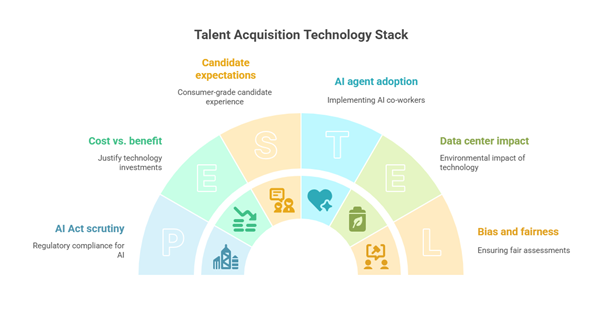
Why Hiring Stacks Fail
Despite the promise, many stocks underperform. Reasons include:
- Over-stacking: too many tools, no integration.
- Under-stacking: relying only on an ATS, leaving gaps.
- Data silos: information locked in vendor systems.
- Shiny object syndrome: buying tools for hype, not solving bottlenecks.
The result: stacks that look modern on a slide but feel broken in practice. Without structured recruitment automation, organizations end up with scattered tools and manual work that cancel out efficiency gains.
Designing Your Hiring Stack: A Framework
A disciplined approach helps:
- Map workflows: identify bottlenecks and drop-offs.
- Classify tools: assign each to a stack layer; reveal redundancies.
- Define non-negotiables: compliance, DEI, and candidate experience.
- Pilot integrations: test how tools work together.
- Future-proof: ensure readiness for AI agents, even if adoption is later.
This isn’t about shopping lists. It’s about architecture.
Case Studies: Stack Thinking in Action
Global Financial Services Firm (Finastra with Codility)Finastra, a leading fintech provider, integrated Codility's technical assessments into their hiring stack to streamline engineering recruitment. This reduced time-to-hire by 28% and cut engineering involvement in the process by 50%, allowing recruiters to focus on high-value sourcing while maintaining hire quality. Over three months, they saved significant interview hours by automating initial coding screens.
High-Growth Employer Using Conversational AI (Sodexo with Paradox)Sodexo used Paradox’s conversational ATS to hire 40,000+ people in seven months, automating screening and engagement. This resulted in a 60% decrease in time-to-hire and a 21% increase in total applications, transforming their high-volume process without expanding the team.
Healthcare Provider (Essentia Health with Paradox)Essentia Health leverages Paradox's Olivia for 24/7 candidate engagement across clinical and non-clinical roles, automating screening and scheduling. This doubled the number of scheduled interviews while reducing administrative burden, enabling recruiters to prioritize meaningful interactions in a competitive labor market.
Large Retail / Hourly Hiring (Compass Group with Paradox)Compass Group hires 160,000 workers annually with a core team of 20 recruiters, relying on Paradox’s automation for screening, FAQs, and scheduling. This achieved a 58% decrease in time-to-apply and a 1:8,000 recruiter-to-hire ratio, scaling national operations without proportional headcount growth.
Each proves the same point: the value lies not in tools, but in the stacked system.
Compliance and Ethics: The Conscience of the Stack
As AI in hiring becomes mainstream, global regulators are demanding transparency, bias audits, and human oversight at every decision point. Hiring is now under regulatory scrutiny worldwide.
- EU AI Act: classifies hiring tools as “high risk.” Requires transparency, audits, and human oversight.
- NYC Local Law 144: mandates annual bias audits for automated employment decision tools.
- UK GDPR Article 22: guarantees candidates the right to human review of automated decisions.
- US EEOC: enforces fairness in AI-driven hiring.
The World Employment Confederation’s AIToolkit 2025 provides transparency checklists, from audit logs to candidate notices.
The HireVue precedent shows what happens when ethics are ignored: public backlash, regulatory pressure, and reputational damage.
Compliance isn’t optional. It is a layer of the stack.
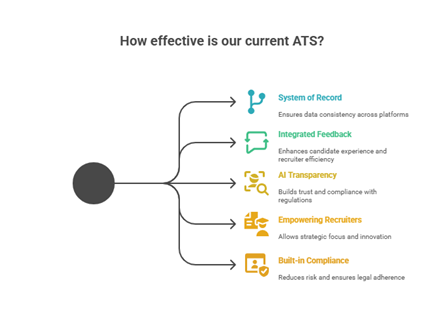
The Talent Leader’s Checklist
Ask yourself:
- Do I have one system of record but multiple systems of intelligence?
- Are candidate touchpoints integrated into feedback loops?
- Can I explain every AI decision to a regulator or candidate?
- Does my stack empower recruiters to focus on strategy?
- Is compliance built-in, not bolted on?
If not, your stack is brittle.
The Future: 2030 Scenarios
What will hiring stacks look like by 2030? Three plausible futures:
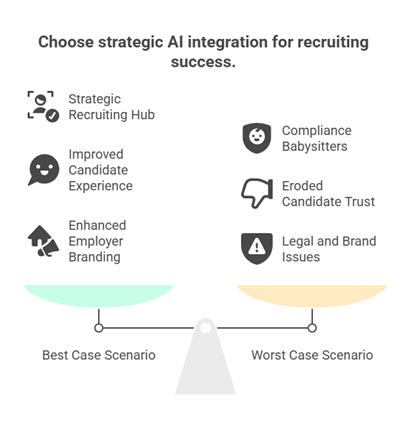
Best Case:
In the best scenarios, AI in hiring enables faster, fairer, and more inclusive decision-making—supported, not replaced, by human recruiters. Recruiting becomes a strategy hub. AI agents handle sourcing, screening, and scheduling. Recruiters advise business leaders, shape employer branding, and align talent to strategy. Candidate experience improves through speed and transparency.
Worst Case:
Organizations over-automate. Candidate trust erodes. Regulators clamp down. Companies face lawsuits, and employer brands suffer. Recruiters become compliance babysitters instead of advisors.
Middle Ground:
Hybrid models dominate. AI handles execution; humans handle persuasion and judgment. Recruiters learn new skills: AI audit, prompt engineering, and data storytelling. Trust is preserved, efficiency gained.
The World Economic Forum predicts HR will be among the most transformed functions by 2030. The choice isn’t whether AI reshapes recruiting — it’s how organizations manage the transition.
Conclusion: Building the Foundation Right
Recruiting has always evolved through its tools. From guilds to ATS to agentic AI, each generation of technology layered on the last.
The hiring stack is not a trend. It is the architecture of modern TA.
If you treat recruiting as a pile of disconnected tools, you’ll fight fires endlessly. If you build a stack — layered, integrated, compliant, and intelligent—you create an ecosystem that frees recruiters to do what only humans can: persuade, connect, and judge potential. The next decade of AI recruiting will reward teams that build integrated stacks, blending data, automation, and human insight into one cohesive system.
Because in hiring, as in music or cooking, the magic isn’t in one instrument. It’s in how the stack plays together.





Stop tracking hiring.
Start running it
We’re onboarding early teams ready to experience AI recruiting that’s faster, smarter, and easier to manage. No fees. No commitments. Just real usage and real feedback.


