


What the Future of Talent Acquisition Should Look Like
Updated On:
February 20, 2026

Reimagining the System, Not Just the Process
The future of talent acquisition reflects the lessons of its era. In the early 1900s, hiring was local and personal — word-of-mouth recommendations, apprenticeships, and handwritten ledgers. Post-war industrialization introduced formal job classifications and psychological testing. Then came the digital revolution, which replaced paper résumés with applicant tracking systems, online job boards, and algorithms.
Now, we stand at another inflection point — one defined by AI, global labor mobility, skills-based economies, and a fundamental rethinking of what “talent” even means.
Hiring can no longer be about filling requisitions. It’s about designing systems that balance exploration and exploitation — discovering untapped potential while still optimizing known talent pools. It’s about aligning ethics with efficiency, data with empathy, and technology with human judgment.
The future of talent acquisition (TA) isn’t a faster conveyor belt. It’s a smarter, fairer, and more adaptive ecosystem — one that treats hiring as a strategic capability, not an administrative function.
(Read more → The Future of talent acquisition)
I. The Core Forces Reshaping Talent Acquisition
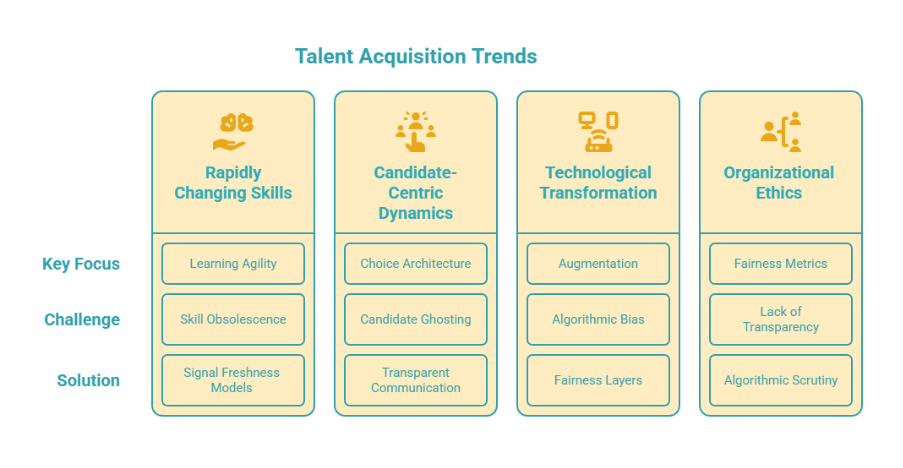
1. Rapidly Changing Skill Landscapes
The shelf life of skills has shortened dramatically. According to McKinsey Global Institute, as many as 375 million workers worldwide may need to transition to new occupational categories by 2030 due to automation and AI.
Hiring managers once relied on credential signals — a college name, a GPA, a title. Research from Harvard Business School and Burning Glass shows that skill-based hiring expands talent pools and widens access, with many roles previously requiring degrees now showing no difference in performance when opened to skilled non-degree candidates.
The future will hinge on skill signal provenance — understanding not just what a candidate knows, but how, when, and where that signal was earned. A bootcamp certificate from two years ago may have decayed in predictive power, while a recent project or open-source contribution might be far more current.
To manage this, companies will need talent analytics models that measure signal freshness — weighting skills by recency and demonstrated application. AI in talent acquisition can help analyze portfolios, code repositories, or real-world project histories to surface proof of ongoing learning.
But the real shift is cultural. We’ll hire less for static mastery and more for learning agility — the ability to adapt, unlearn, and re-skill as roles evolve. In that sense, adaptability becomes a first-class hiring signal, not a soft skill.

2. Candidate-Centric Dynamics
Candidates are no longer passive participants. They navigate hiring processes like consumers, comparing brand promises, employer authenticity, and process fairness.
SHRM’s 2025 Talent Trends report reveals that 41% of organizations report an increase in candidate “ghosting” (i.e., applicants suddenly ending communication without explanation) during the interview process, highlighting the need for more engaging and transparent journeys.
To fix it, TA teams must adopt choice architecture — designing candidate journeys with the same intentionality marketers design user experiences. That means:
- Transparent timelines and feedback loops.
- Mobile-first application flows (90% of candidates now use phones for job searches, per Pew Research 2025 updates).
- Contextual nudges (“You’re halfway done, here’s what’s next”).
- Humanized touchpoints post-AI screening.
Candidate experience isn’t just goodwill; it’s ROI. Deloitte research shows that organizations with strong candidate experiences see 20–30% higher acceptance rates and improved talent outcomes compared to those with poorly designed hiring journeys.
3. Technological Transformation
AI isn’t replacing recruiters; it’s redefining their role. Tools like large language models (LLMs) already draft job descriptions, screen résumés, and even analyze video interviews. But the deeper transformation is conceptual — from automation to augmentation.
AI in recruitment enables recruiters to test hypotheses: Which traits predict success in hybrid environments? Which micro-credentials correlate with faster ramp-up times?
Meanwhile, blockchain-based credential systems will enable verifiable, tamper-proof records of education and work experience. Imagine a world where candidates carry “talent wallets” — portable profiles containing verified skills, references, and performance data that employers can trust instantly.
Yet the same technologies introduce new fairness dilemmas. Research published on arXiv shows that AI models trained on non-diverse data demonstrate measurable linguistic bias, potentially disadvantaging non-native or culturally diverse candidates.
That’s why the next generation of TA systems must embed ethical hiring practices: localized evaluation, linguistic calibration, and explainability dashboards. Transparency won’t just be compliance — it’ll be a brand differentiator.
4. Organizational Ethics and Transparency
Every algorithm leaves fingerprints. Upturn’s landmark report on hiring algorithms concluded that automated hiring systems can unintentionally replicate existing societal biases, including those linked to geography, education history, and language patterns.
Companies that treat ethics as a checkbox will fall behind. The forward-looking ones will publish their fairness metrics in annual reports, display candidate-rights policies on career pages, and offer audit trails for contested decisions.
This is how trust will be built in a post-AI hiring world: not by hiding algorithms, but by inviting scrutiny — the foundation of truly ethical hiring practices in the future of recruiting.
II. Unexplored Dimensions That Will Define Competitive Advantage
1. Adaptability and Learning Agility
Learning agility — the capacity to acquire and apply new skills quickly — is emerging as one of the best predictors of long-term performance. Decades of leadership research — including studies published in Personnel Psychology — show that learning agility is one of the strongest predictors of long-term leadership performance.
In the future, assessments might simulate unfamiliar scenarios and track how candidates navigate ambiguity rather than testing rote knowledge. “Can this person learn faster than the problem changes?” will become the new north star question.
Organizations that hire for agility, then invest in development, will outperform those that chase pre-baked skills — embedding adaptability into their talent acquisition strategy.
2. Assessor Bias and Human-in-Loop Design
Human evaluators introduce variability too. Peer-reviewed research published in SAGE Journals shows that gender bias in evaluations can occur in various hiring contexts, influenced by evaluator perceptions and gender stereotypes.
Many human-in-loop systems simply rubber-stamp AI decisions — reproducing bias with human validation. The fix isn’t removing humans; it’s redefining meaningful oversight:
- Training evaluators on cognitive bias awareness.
- Rotating panels for diverse perspectives.
- Logging every override or acceptance of AI recommendations for auditability.
Recruiters of the future won’t just manage pipelines; they’ll manage systems of accountability — ensuring fairness across AI in recruitment workflows.
3. Scenario Planning for Regulatory Shock
The coming AI Act in Europe, along with emerging U.S. state laws, will reshape TA practices. Some tools might become restricted or require third-party audits.
Smart organizations will prepare “compliance-pivot” playbooks: modular workflows where algorithmic stages can be swapped for human review when laws change. Maintaining readiness for regulatory volatility will be as critical as sourcing strategy itself — another hallmark of resilient talent acquisition strategy.
4. Measuring Downstream Value
Current TA metrics — cost-per-hire, time-to-hire, quality-of-hire — describe efficiency, not impact. But future talent analytics dashboards will measure downstream value:
- Retention after 12–24 months.
- Internal mobility and promotion velocity.
- Innovation or cross-functional contributions.
- Onboarding completion and cultural assimilation.
Hiring data should connect directly to performance data. The feedback loop between recruiting and business outcomes will finally close, reinforcing the strategic value of recruitment automation.
5. Scalability vs Customization
Global firms face a paradox: scaling consistency while respecting local norms. An assessment calibrated for the U.S. might penalize Indian or Brazilian candidates for linguistic variance.
The solution lies in locale-aware AI — regionally tuned benchmarks and multilingual training data — coupled with human contextualization. Global TA won’t mean uniform; it’ll mean equitable. That balance defines the next frontier for AI in talent acquisition.

III. Emerging Talent Markets
1. Decentralized and Peer-to-Peer Hiring
As blockchain and verifiable credentials mature, we’ll see decentralized marketplaces where freelancers and micro-teams verify their experience through cryptographic proofs.
Imagine a decentralized “LinkedIn DAO” where peers endorse each other’s work through smart contracts, or hiring decisions validated by network reputation instead of centralized intermediaries.
This model reduces fraud, increases trust, and democratizes access — especially for workers in emerging economies traditionally excluded from global hiring pipelines — reshaping the future of recruiting itself.
2. Internal Talent Marketplaces
The distinction between talent acquisition and talent management is collapsing. Internal talent marketplaces now allow employees to bid for internal gigs, cross-functional projects, or lateral moves.
This internal mobility doesn’t just save cost — it builds resilience. Employees stay longer, engagement rises, and institutional knowledge compounds.
LinkedIn’s Global Talent Trends 2025 reports that internal mobility has increased 6% year-over-year, with companies leveraging it seeing nearly 7% higher retention at the 3-year mark for employees who learn skills on the job. While exact internal fill rates vary by industry, forward-thinking organizations often fill 15–25% of roles internally through these programs, boosting both retention and agility. The future recruiter will spend as much time rediscovering internal talent as sourcing external candidates.

IV. The Data and Analytics Backbone
Predictive talent analytics is already used to forecast turnover or identify sourcing bottlenecks. But future TA analytics will go further — modeling labor market dynamics, skill obsolescence, and internal learning curves.
Organizations will maintain live dashboards tracking:
- Emerging skills demand in their industry.
- Internal skill inventory and gaps.
- Exploration vs exploitation ratios in sourcing (how much we’re hiring from new pools).
In the future of talent acquisition, analytics won’t just inform hiring decisions — it will define how organizations anticipate and shape workforce evolution.
V. Human + Machine Collaboration
AI will become the silent co-recruiter — drafting, scoring, predicting. But humans will remain the meaning-makers.
The real question is governance: Who owns final decision rights? How do we handle disagreements between model and manager?
A mature AI in talent acquisition system might look like this:
- AI screens and scores candidates.
- Human recruiter reviews edge cases and contextual anomalies.
- Both decisions are logged, compared, and fed back for model retraining.
This “closed feedback loop” ensures AI learns accountability while humans learn from patterns — a virtuous cycle of shared intelligence.
Transparency dashboards, visible to both recruiters and candidates, could show which criteria were applied at each stage. Imagine candidates seeing: “Your résumé was evaluated for X, Y, Z; here’s how you can improve next time.” That transparency builds trust and drives a better candidate experience.
VI. Global and Cultural Considerations
Globalization has made talent markets fluid, but fairness isn’t equally distributed. LLM-based interview systems have been shown to misclassify non-native English speakers, scoring them lower for “communication clarity.”
To build equitable systems, organizations must:
- Test AI in recruitment tools on diverse linguistic datasets.
- Offer localized fairness audits.
- Tailor EVP (employee value proposition) to regional expectations.
Cultural competence will become a competitive advantage. The recruiter of 2030 will need the empathy of a sociologist and the data literacy of an analyst — a blend of ethical hiring practices and technical fluency that defines the next evolution of TA.
VII. Building the Strategic Framework for TA 2.0
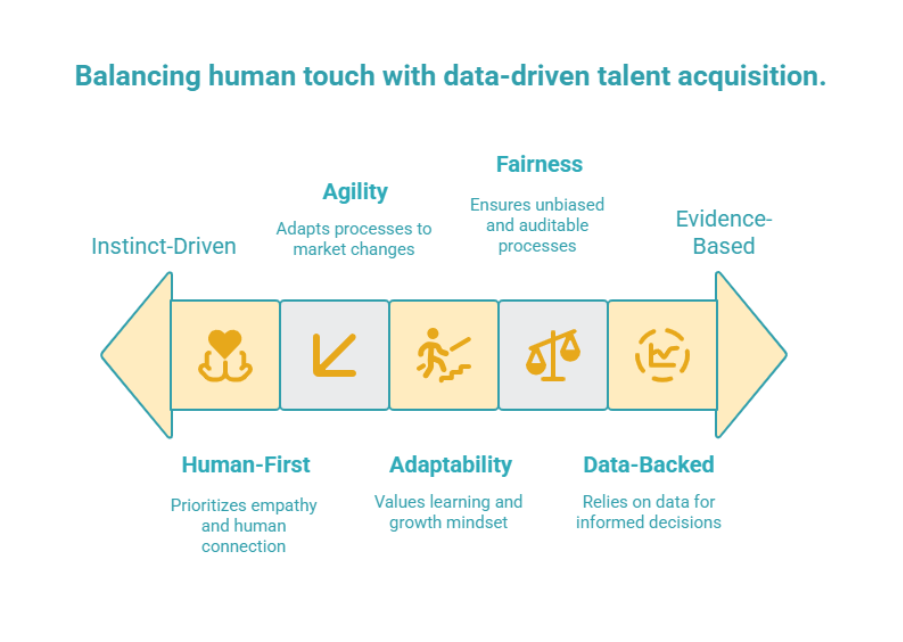
Guiding Principles
- Agility: Design hiring processes that can flex with market or regulatory change.
- Fairness: Bake in auditability and bias testing from the start.
- Adaptability: Prioritize learning agility in both candidates and TA teams.
- Human-First: Use automation to free up time for empathy, not replace it.
- Data-Backed: Ground every decision in evidence, not instinct.
Future-ready TA teams will be built on a strong talent acquisition strategy — one that fuses ethics, analytics, and innovation.
Organizational Design
Future TA functions will be multidisciplinary ecosystems, with specialized roles such as:
- AI Ethics Officer — ensures algorithmic transparency and fairness.
- Talent Data Analyst — connects hiring data with performance outcomes.
- Candidate Experience Designer — architects the candidate journey like a product.
- Internal Mobility Partner — bridges recruitment and learning teams.
Together, they’ll form an operating model closer to a talent intelligence function than traditional recruitment.
Implementation Roadmap
Short-Term (1–2 years)
- Integrate skill-based assessments.
- Audit AI tools for bias and explainability.
- Improve candidate communication loops.
Medium-Term (3–5 years)
- Launch internal talent marketplaces.
- Adopt decentralized credential verification.
- Implement predictive dashboards linking hiring to retention and innovation.
Long-Term (5+ years)
- Fully integrate TA with workforce planning and L&D.
- Model workforce evolution scenarios (regulatory, technological, demographic).
- Embed TA as a strategic forecasting engine within the enterprise.
VIII. Future Scenarios and Thought Experiments
The next wave of recruitment automation will prioritize augmentation over replacement. Automation will handle volume; humans will handle nuance.
What if decentralized credential networks become mainstream? Recruitment may move from corporate control to community validation, democratizing opportunity.
What if the next wave of automation leads to hyper-specialized talent scarcity? TA functions might evolve into workforce architects — designing ecosystems of contractors, AI agents, and hybrid roles.
These scenarios aren’t science fiction; they’re policy decisions in motion. Preparing for them now will separate resilient organizations from reactive ones.
IX. The Candidate’s Agency
AI bias in recruitment remains one of the most pressing challenges in modern hiring. From resume parsing to video interviews, bias can appear in any step if unchecked.
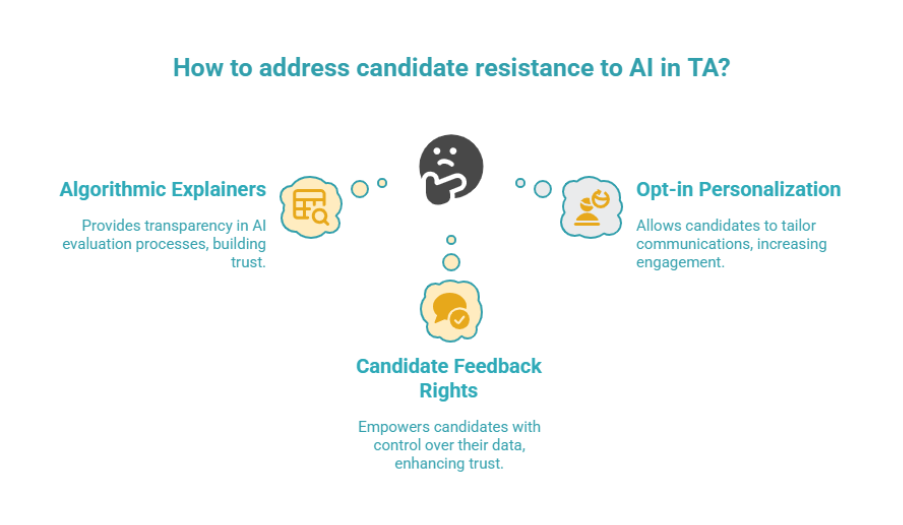
This arms race will push companies to re-humanize their processes — to reintroduce trust as a differentiator. Candidates don’t mind AI when it’s transparent; they revolt when it feels opaque or manipulative.
The next evolution of candidate experience might include:
- Algorithmic explainers (“Here’s how we evaluate applications”).
- Candidate feedback rights (“Request your assessment summary”).
- Opt-in personalization (“Allow us to tailor communications based on your preferences”).
Hiring, in other words, becomes a dialogue again.
X. Sustainability and Ethics as Strategic Pillars
Candidates increasingly evaluate employers by their environmental and social commitments. ESG data will become part of employer branding. TA can spotlight sustainable practices — green jobs, ethical sourcing, inclusive hiring — as differentiators.
Sustainability in hiring also means maintaining ethical infrastructure: governance committees, bias monitoring, and transparency reports. It’s not peripheral; it’s existential.
XI. Conclusion: From Pipelines to Ecosystems
The future of talent acquisition isn’t about better pipelines; it’s about better systems of judgment.
The most successful organizations will treat TA as an intelligence function — one that learns, adapts, and acts with conscience. They’ll design hiring architectures that balance efficiency with empathy, data with dignity.
Recruiters will evolve into workforce strategists. Algorithms will become collaborators, not arbiters. Skills will matter more than titles; adaptability more than pedigree.
The companies that master this balance — human and machine, local and global, fairness and performance — won’t just hire better. They’ll build workforces capable of reinventing themselves as fast as the world changes.
Because the real future of talent acquisition isn’t automation.
It’s alignment — between who we hire, how we hire, and why it matters.





Stop tracking hiring.
Start running it
We’re onboarding early teams ready to experience AI recruiting that’s faster, smarter, and easier to manage. No fees. No commitments. Just real usage and real feedback.


