


The Real Cost of Talent Decisions Without Decision Intelligence
Updated On:
February 20, 2026

The Hidden Cost of Hiring
Somewhere between a rushed interview and a gut instinct, a company quietly positions itself to lose money. A single wrong hire, the kind made because someone “felt right,” can cost anywhere between half and twice the employee’s annual salary according to research from Gallup and SHRM. In India, several industry surveys estimate that the cost for a mid-level professional often falls between fifteen and thirty lakh rupees once onboarding, training, lost productivity, and replacement efforts are included.
Yet the monetary loss is only the beginning. Poor talent decisions quietly alter the strategic course of an organization. A project falls behind. A client relationship weakens. A team loses momentum. Culture absorbs friction that no one intended. The troubling reality is that most of this waste is predictable and preventable.
Despite access to vast data, modeling power, and decades of validated research, many organizations still make talent decisions that resemble the practices of 1975. The gap lies not in the availability of insights but in the systems that convert insight into consistent action. That missing link is decision intelligence, a discipline that unites data science, psychology, and decision design to improve outcomes.
A Century of Trying to Measure People
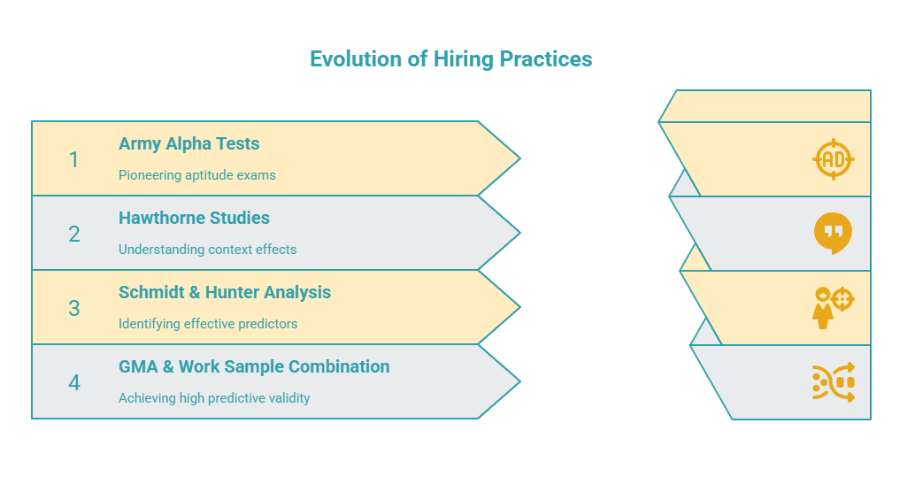
Hiring did not begin as guesswork. During World War I, the U.S. Army introduced the Army Alpha tests, the first large-scale aptitude assessments used to match recruits with roles. The insight was simple: structured measurement reduces mismatch.
The Hawthorne studies in the 1920s and 1930s revealed that human performance is shaped by context and observation. These findings helped launch industrial and organizational psychology. Over decades, researchers refined methods that balanced human judgment with validated predictors.
By the late twentieth century, Schmidt and Hunter conducted a landmark meta-analysis covering eighty five years of selection research. They identified the predictors that reliably forecast job performance: General Mental Ability, Work Sample Tests, Structured Interviews, and Integrity Tests. Combining General Mental Ability with Work Sample Tests can explain more than sixty percent of performance variability.
Despite such strong evidence, most hiring processes still depend on unstructured interviews and résumé screens that have low predictive validity. We know what works. We simply lack systems that make it easy to apply what works at scale. This is where people analytics and decision intelligence intersect.
What the Evidence Really Says About Hiring Accuracy
Schmidt and Hunter’s research is still the cornerstone of hiring analytics. Their work demonstrated that methods like unstructured interviews barely outperform chance, while structured interviews and validated assessments significantly reduce error. When these differences are translated into economic impact, the gap becomes difficult to ignore.
From a decision intelligence viewpoint, predictive validity is not just a technical metric. It is a direct predictor of preventable cost. Organizations that rely on low-validity methods unknowingly accept high error rates and the financial losses associated with them.
The Hidden Cost of a Bad Hire
Most leaders focus on recruiting fees or onboarding time when estimating the cost of a mis-hire. These visible expenses represent only a small portion of the true impact.
Direct costs include hiring, screening, onboarding, and the salary paid to an underperforming employee.
Indirect costs include lost productivity, delays in project delivery, manager time spent on remediation, reduced morale, and increased turnover risk among high performers.
Risk costs include legal exposure, client dissatisfaction, and potential damage to business reputation.
Organizations without data-driven hiring practices or strong workforce analytics often underestimate how far these ripple effects extend.
The Statistical Heart of Talent Decisions
Hiring accuracy can be modeled mathematically. Let p(good) represent the probability of selecting a strong performer and C(error) represent the cost of selecting a poor performer. Expected cost per hire equals p(good) multiplied by the value of a successful hire plus the probability of an error multiplied by the cost of that error.
As organizations shift from low-validity methods to validated predictors, p(good) increases. Moving from a probability of 0.6 to 0.8 reduces expected cost by nearly forty percent. This improvement reflects the value of a decision intelligence framework, supported by artificial intelligence and decision making models.
The Human Cost You Cannot Quantify in a Spreadsheet
Financial waste is only part of the story. Poor talent decisions affect culture and psychological well-being. Research across organizational psychology consistently shows that mismatches between role and skill increase stress and disengagement. When employees perceive hiring decisions as inconsistent or unfair, trust erodes and psychological safety declines.
Modern people analytics demonstrates how misalignment affects collaboration and innovation. Teams lose momentum when energy is spent compensating for a mismatch. Leaders lose credibility. Engagement weakens. Strong intelligent decision systems help reverse these cultural losses by promoting fairness, transparency, and clarity.

Why Analytics Alone Is Not Enough
Many organizations invest heavily in dashboards and analytics but see little change in outcomes. Analytics shows what is happening; it does not ensure better decisions.
Decision intelligence with AI moves organizations from prediction to action. It introduces decision design, governance, and feedback loops so performance improves continuously. Without this shift, insights remain unused and hiring errors remain unchanged.
Read more: Recruitment Intelligence: The Missing Layer in Talent Acquisition
Building a Decision-Intelligent Talent System
A mature talent system grounded in decision intelligence includes several components:
- Clear definitions of the decisions that matter most, such as hiring, development, and succession.
- Adoption of validated predictors backed by decades of research.
- Statistical modeling to estimate expected costs and benefits.
- Long-term pilots that measure outcomes over twelve to twenty four months.
- Fairness checks, audit trails, and decision governance.
- Continuous learning loops where performance data improves future decisions.
Organizations that adopt structured decision models and advanced analytics report significant improvements, including reductions in turnover and increases in productivity.
Common Failure Patterns and How to Overcome Them
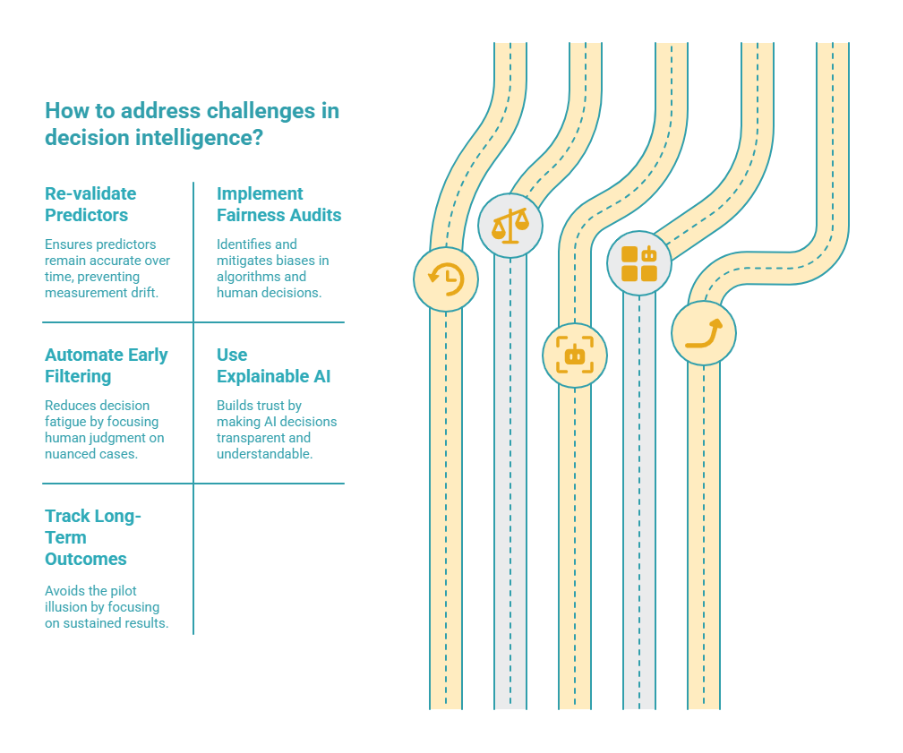
Every decision system encounters challenges. Predictors can drift as job roles evolve. Human and algorithmic biases can emerge. Recruiters overwhelmed by workload may default to fast but low-quality decisions. Managers may hesitate to trust unfamiliar methodologies.
These issues point to gaps in HR data governance and intelligent decisioning, not flaws in the concept of decision intelligence. When tracked and addressed consistently, these challenges become sources of growth.
Read more: ATS vs Agentic AI: What’s Changing and Why It Matters
A Real-World Example of Economic Impact
Consider an organization that hires fifty mid-level engineers annually at an average salary of one hundred thousand dollars. If a poor hire costs roughly eighty thousand dollars, and the hiring method has a predictive validity that results in a sixty percent success rate, a significant portion of payroll is at risk. By shifting to validated predictors that increase success likelihood to eighty percent, the organization can save hundreds of thousands of dollars annually. This illustrates the real practical value of AI decision intelligence.
The Long Tail of Talent Decisions
A poor hiring choice influences more than immediate performance. It affects promotions, skill development, team configuration, and long-term succession planning. Without strong workforce analytics and reliable decision intelligence software, misallocations persist for years, affecting future competitiveness.
The Psychological Ledger of Decision Quality
Employees observe patterns in hiring, promotion, and recognition. When the logic behind these decisions is unclear, trust and engagement decline. Studies across behavioral science consistently show that fairness and transparency enhance psychological safety and performance.
Systems that integrate artificial intelligence for decision making with clear communication help employees understand how decisions are made. This trust creates a climate where collaboration and discretionary effort thrive. These benefits, although often unmeasured, significantly influence long-term organizational success. This is the strength of intelligent decision design.
The Realities of Implementing Decision Intelligence
Decision intelligence requires investment. Data pipelines must be integrated, teams trained, and governance structures created. However, organizations that adopt structured decision systems often report strong returns as turnover decreases and performance becomes more predictable.
When Decision Intelligence Falls Short
Not every pilot or model delivers expected results. Some underperform due to poor data quality, unclear ownership, or misinterpretation of model outputs. Documenting and learning from these scenarios strengthens future implementation. A strong decision intelligence framework grows through iteration, not perfection.
From Intuition to Intentionality: The Leadership Shift
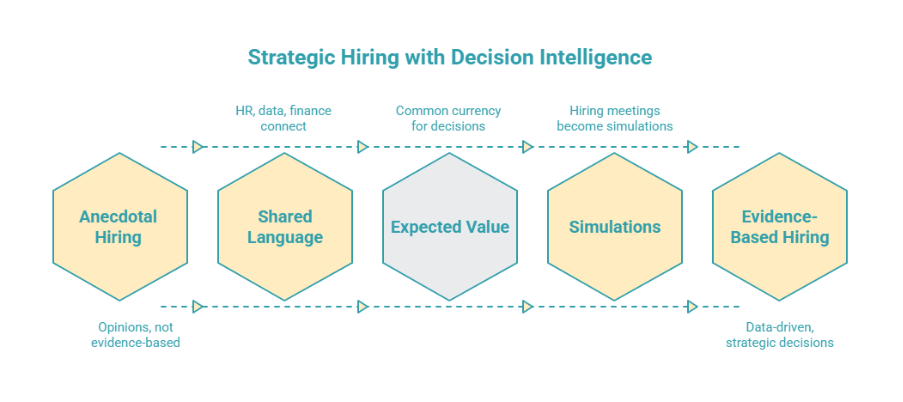
Hiring quality ultimately reflects leadership philosophy. Organizations that treat hiring as a strategic decision, rather than routine administration, see compounding improvements in talent quality. Decision intelligence creates a shared language for HR, data teams, and finance. HR brings knowledge of people and culture. Data teams analyze patterns and probabilities. Finance evaluates cost and return. Together they build decisions grounded in measurable value rather than instinct.
The Road Ahead
The next five years will distinguish organizations that genuinely learn from data from those that simply collect it. Automation will expand, but sustainable advantage will belong to companies that decide with intelligence. AI decision intelligence does not replace intuition. It strengthens it. It enables leaders to use their judgment with clarity and evidence.
Organizations that thrive will be those where every significant talent choice is designed thoughtfully. Talent is not a headcount line. It is the accumulated effect of every decision an organization makes about people.
Takeaway
Decision intelligence with AI transforms hiring from a gamble into a reliable system. It reduces errors, increases transparency, and converts human judgment into long-term strategic value. In a rapidly changing world, this capability is not simply an advantage. It is essential for survival.





Stop tracking hiring.
Start running it
We’re onboarding early teams ready to experience AI recruiting that’s faster, smarter, and easier to manage. No fees. No commitments. Just real usage and real feedback.


