


ATS vs Agentic AI: What’s Changing and Why It Matters
Updated On:
February 20, 2026
Why This Debate Matters in 2025
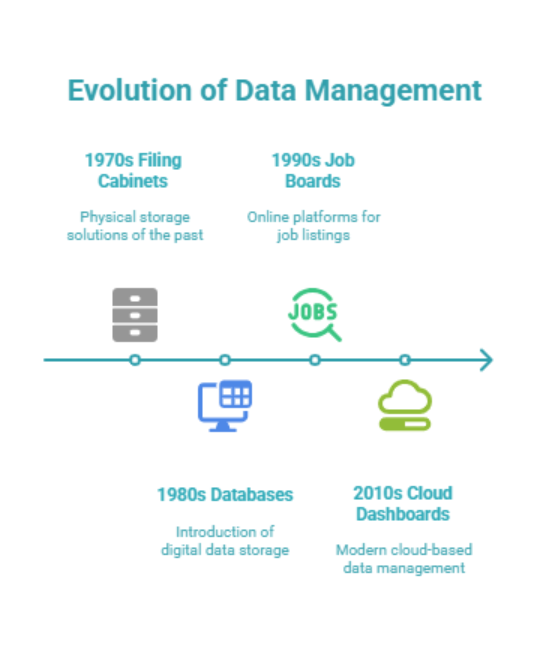
Recruitment has always evolved alongside the tools of its time. In the 1970s, it was filing cabinets and rolodexes. The 1990s brought keyword filters and online databases. By the 2010s, cloud dashboards and analytics promised precision at scale. At every stage, the goal stayed constant — to make hiring faster, fairer, and more efficient.
Yet in 2025, familiar pain points remain: inefficiencies, bias, ghosting, and the infamous “résumé black hole.” For all their ubiquity, Applicant Tracking Systems (ATS) have plateaued. They track, store, and report — but they don’t think, decide, or act. They’re digital ledgers in an era demanding intelligence.
Enter the new paradigm: agentic AI in recruitment. Unlike ATS, which merely manage data, agentic systems can reason and execute. They don’t just record who applied — they proactively source talent. They don’t wait for human triggers — they autonomously screen, schedule, and engage within defined ethical boundaries.
According to Deloitte, by 2027, over half of organizations experimenting with generative AI will pilot agentic AI hiring systems. McKinsey calls the future of work “agentic,” powered by multi-agent systems that collaborate to recruit without manual oversight. Yet Gartner warns of “agent washing,” as legacy vendors rebrand simple automations as “AI agents.”
So the question for HR leaders isn’t whether AI belongs in hiring — it’s whether to stay with systems designed to track, or pivot toward systems designed to act. This isn’t just a technology decision; it’s a strategic one. In the race between ATS vs agentic AI, the outcome will define the next decade of talent acquisition.
From Filing Cabinets to Digital Dashboards: The ATS Story
To understand why the shift from ATS to agentic AI matters, it helps to trace how hiring systems evolved — and where they stopped evolving.
Before the 1970s, recruitment was a paper maze. Resumes stacked in folders, interviews logged in calendars, compliance tracked in binders. Recruiters were the gatekeepers of information, limited by time and physical reach.
Then came the first digital revolution. The earliest Applicant Tracking Systems (ATS) of the 1980s transformed filing cabinets into databases. They centralized resumes, created audit trails, and introduced a new standard for compliance and record-keeping. For the first time, hiring could be measured and managed digitally.
The 1990s brought the internet — and chaos. Job boards like Monster and CareerBuilder turned application volume into a flood. Recruiters who once managed dozens of candidates now faced thousands. Keyword filters became the lifeline. AI driven recruitment was still decades away; back then, “automation” meant Boolean search strings.
By the 2010s, cloud-based ATS platforms dominated the enterprise market. They added analytics dashboards, automated emails, and mobile access. By 2020, 99% of Fortune 500 companies used some form of ATS. Yet the complaints were identical to those from the 1990s: candidates felt unseen, recruiters felt overwhelmed, and hiring cycles stretched endlessly.
The truth is, ATS systems did what they were built for — they tracked. They never learned to act. They solved logistical problems, not strategic ones. What AI driven recruitment brings is the next leap: systems that don’t just manage workflows but optimize outcomes.
The ATS digitized hiring. Agentic AI promises to humanize it again — through systems that see, decide, and learn instead of merely record.
The Strengths and Limits of ATS
Applicant Tracking Systems persist because, in many ways, they still work. They bring structure to chaos, compliance to complexity, and order to volume. But in the age of AI for talent acquisition, their limitations have never been more visible.
What ATS does well:
- Centralization: ATS platforms consolidate candidate data, keeping recruitment auditable and compliant.
- Scalability: A single recruiter can manage thousands of applicants across multiple openings.
- Integration: They connect with job boards, CRMs, and HRIS systems, creating a unified digital trail.
- Consistency: Every applicant follows the same documented process, reducing human error.
These are strengths — but they’re also constraints.
- Keyword bias: The system’s logic still depends on keyword matching, not contextual understanding. Qualified candidates often get screened out because their résumés don’t fit predefined templates.
- Candidate alienation: Applicants describe the process as impersonal — an algorithmic black box that rarely communicates or explains decisions.
- Data silos: ATS store information but seldom learn from it. They accumulate history without generating intelligence.
- Recruiter overload: Recruiters spend more time maintaining dashboards than engaging with people.
In short, the ATS remains a system of record, not a system of intelligence. It optimizes logistics but not decision-making.
The transition toward AI for talent acquisition is therefore not a replacement but a redefinition — moving from systems that record activity to systems that improve judgment. Where the ATS managed information, agentic AI manages intent.

The Rise of Agentic AI in Hiring
The term agentic AI marks a decisive shift in how hiring systems operate. Traditional AI supports recruiters by suggesting actions or generating content. Agentic AI takes a step further. It interprets intent, executes tasks, and learns from outcomes within clearly defined boundaries.
Earlier automation was about efficiency. Agentic AI hiring is about autonomy. It gives systems the capacity to make informed decisions and act on them responsibly.
In recruitment, this means:
- Proactive sourcing: AI agents search databases, professional networks, and internal talent pools without waiting for a human prompt.
- Autonomous workflows: Agents handle interview scheduling, reminders, and coordination seamlessly across time zones.
- Conversational engagement: Candidates interact with intelligent chat agents that provide updates, answer questions, and share preparation tips.
- Outcome learning: When a candidate is hired, agents analyze what worked and refine their matching criteria for the next cycle.
McKinsey reports that generative AI is accelerating automation across HR, particularly in sourcing, screening, and candidate engagement. HR.com surveys show rapid year-over-year growth in HR’s use of AI for sourcing, screening, and communication. The World Economic Forum reports that AI will automate up to 42% of business tasks by 2027, including parts of sourcing and screening workflows.
This evolution is not a minor upgrade. It represents a fundamental redesign of hiring architecture — from systems that simply track applicants to systems that understand and act.
ATS vs Agentic Systems: The Core Differences
The difference between ATS and agentic AI systems is more than a technical upgrade. It represents a change in philosophy — from systems that record data to systems that make informed decisions.
Key distinctions:
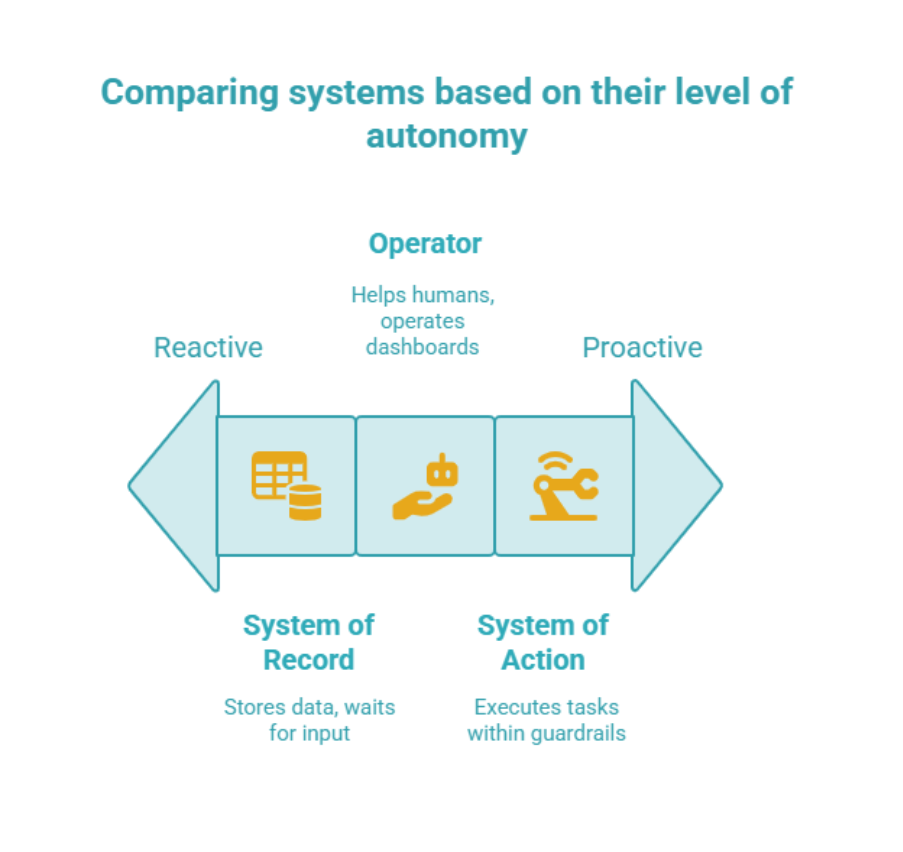
- System of record vs. system of action. ATS stores. Agents do.
- Passive vs. proactive. ATS waits. Agents seek.
- Assistive vs. autonomous. ATS helps humans. Agents execute within guardrails.
- Operator vs. advisor. Recruiters operate ATS dashboards. With agents, they advise strategy.
- Recruiter Role: In an ATS, recruiters act as operators managing workflows. In agentic AI hiring, they guide and oversee outcomes.
- Keyword filters vs. contextual reasoning. ATS screens text strings. Agents interpret context, skills, and fit.
- Opaque vs. transparent. ATS frustrates candidates. Agents provide feedback loops and updates.
The agentic AI advantages are clear: more intelligent automation, better candidate experiences, and decision-making that improves over time.
Why Now? The Convergence of Forces
The shift from ATS to agentic AI systems is not happening by chance. Several forces have converged to make this the right moment for change.
- Market urgency. Speed-to-hire now determines competitive edge. In tight talent markets, slow processes mean losing the best candidates.
- Technology maturity. LLMs, embeddings, and orchestration frameworks now allow multi-agent systems to coordinate tasks seamlessly.
- Candidate expectations. Candidates demand transparency, feedback, and personalization. They won’t tolerate ghosting or the “black hole.”
- Regulation. The agentic AI trend is also driven by new compliance standards. The EU AI Act and local bias audit laws demand fairness, explainability, and human oversight.
The result: enterprises are no longer asking if they should evolve beyond ATS, but how fast.
Strategic Benefits of Agentic AI
As more organizations adopt agentic AI in recruitment, the benefits are becoming measurable. These systems deliver improvements across efficiency, quality, and experience — the three pillars of effective hiring.
- Efficiency gains. Companies using agentic scheduling and screening agents are seeing major efficiency gains, with recruiter productivity increasing by up to 75 percent. High-volume platforms like Fountain and Paradox report 70–85 percent faster time-to-interview and over 50 percent lower early-stage drop-off.
- Candidate dignity. Instead of “resume roulette,” candidates get real-time updates, prep tips, and conversational interfaces.
- Improved quality of hire. Agents learn from outcomes, refining matching logic to prioritize fit, not just keyword alignment.
- Competitive advantage. In markets where top candidates vanish in days, faster decision-making means winning the talent race.
- Scalability. Global talent pipelines can be engaged 24/7, without recruiter fatigue.
The data supports it: agentic AI 2025 adoption delivers both operational and strategic lift, turning recruitment from a reactive process into an intelligent, adaptive system.
Risks, Myths, and Failure Modes
But every leap has pitfalls.
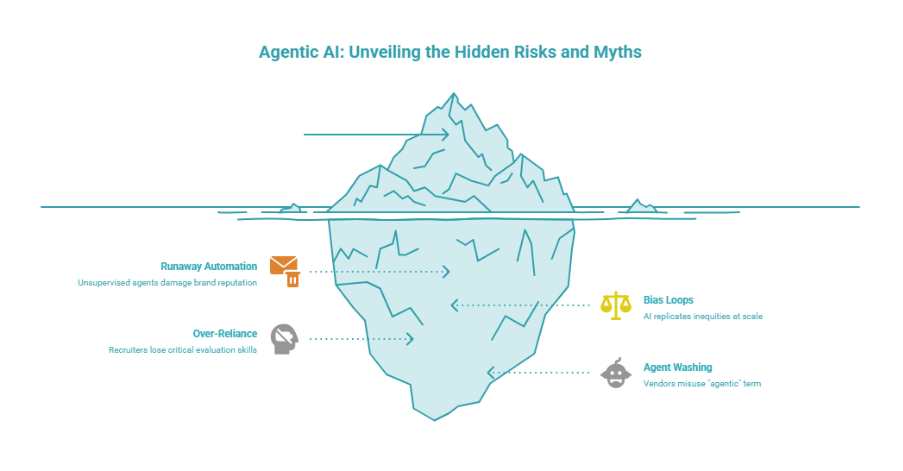
- Runaway automation. An unsupervised agent could flood candidates with irrelevant outreach, damaging brand reputation.
- Bias loops. If agents learn from biased data, they’ll replicate inequities at scale.
- Over-reliance. Recruiters risk losing critical evaluation skills if they delegate too much.
- Agent washing. Vendors misuse “agentic” to describe glorified chatbots.
In every deployment, AI hiring compliance must guide adoption. Guardrails, audit trails, and fairness testing ensure that autonomy does not come at the cost of accountability.
The Human Dimension: Recruiters and Candidates in 2030
Technology changes workflows, but it also reshapes identities. AI agents in HR are not replacing people; they are redefining roles.
Recruiters in the ATS era became “system operators,” defined by dashboards and compliance. In the agentic era, their role expands. They become strategic advisors, shaping hiring philosophy, curating culture fit, and guiding AI to make fair, high-quality decisions.
For candidates, the transformation is equally dramatic. Instead of being ghosted by an ATS, they interact with conversational systems that provide feedback, updates, and preparation. Instead of opacity, they get transparency. Done right, agentic AI restores dignity to the candidate journey.
By 2030, AI agents in HR will handle repetitive tasks so humans can focus on the relational aspects of hiring. The future recruiter is not a gatekeeper but a guide who ensures fairness and empathy in an increasingly automated system.
Cross-Industry Parallels
Recruitment isn’t unique. Similar shifts are happening across industries:
- Finance: from ledger software to autonomous trading agents.
- Healthcare: from scheduling apps to triage AI.
- Supply chain: from ERP dashboards to AI logistics agents rerouting shipments in real time.
Recruiting’s evolution is part of this larger story: moving from systems of record to systems of action.
Global Adoption Patterns
Adoption looks different across regions.
- U.S. and Europe. Regulatory oversight drives adoption, with bias audits and GDPR shaping system design.
- India and Southeast Asia. Cost efficiency and scale are primary drivers. Agentic systems offer affordable automation.
- China. State-backed HR tech initiatives push agentic AI for workforce planning and national competitiveness.

The Future of Talent Systems
Three futures are possible.
- ATS evolves. Traditional platforms bolt on agentic features, creating “Agentic ATS.”
- Replacement. Agentic systems displace ATS entirely, creating “Talent Operating Systems.”
- Hybrid decade. ATS remain for compliance tracking while agents run the real workflows.
Most enterprises will experience scenario three over the next decade. But by 2030, the ATS as we know it may be a compliance relic, while agents orchestrate hiring end to end.
Strategic Guidance for Leaders
The transition from ATS to agentic systems is not about adopting another tool. It is about transforming recruitment into a living, adaptive ecosystem powered by AI recruitment automation.
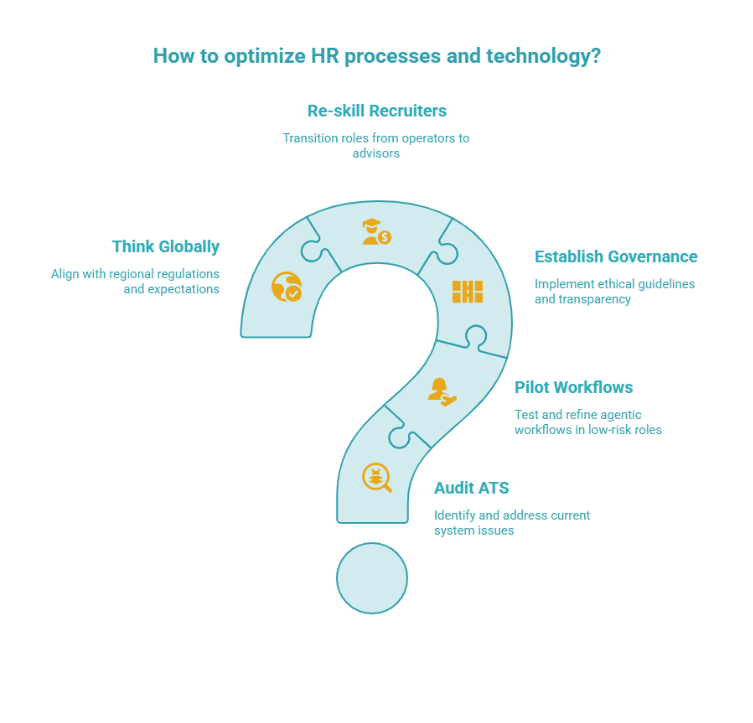
Checklist for HR Leaders:
- Audit your ATS. What problems does it still solve? Where does it fail?
- Pilot agentic workflows in low-risk roles. Learn before scaling.
- Establish governance: bias audits, transparency logs, ethical guidelines.
- Re-skill recruiters: from operators to advisors.
- Think globally: align adoption with regional regulations and expectations.
The stakes are high. In a world where speed-to-talent determines business outcomes, sticking with a system built to track may not be enough.
(Read more → AI Recruiting Platforms Compared: What Matters in 2025)
FAQs
Q1: What is the difference between ATS and agentic AI in recruitment?
ATS platforms store and track candidate data, while agentic AI systems interpret information, make decisions, and execute hiring actions autonomously.
Q2: How does agentic AI improve hiring outcomes?
It evaluates skills, context, and fit instead of relying on keywords, resulting in faster, fairer, and more accurate candidate selection.
Q3: Is agentic AI compliant with hiring regulations?
Yes. Under the EU AI Act recruitment framework, companies must ensure bias audits, documentation, and human oversight for full AI hiring compliance.
Q4: Can agentic AI replace recruiters?
No. Agentic systems automate repetitive tasks, but human judgment remains essential for ethics, empathy, and final decisions.
Q5: What should companies look for in the best AI recruiting software?
The best AI recruiting software combines transparency, fairness, and continuous learning while integrating seamlessly with existing HR systems.
Conclusion: From Tracking to Acting
The ATS was born in an age of paperwork and compliance. It served its purpose, bringing order to chaos. But today’s challenges—global competition, candidate expectations, regulatory oversight—demand more.
Agentic systems represent not just new technology, but a new philosophy. They promise a hiring process that is faster, fairer, and more transparent. They shift recruiters from operators to strategists, and candidates from entries in a database to humans in a conversation.
The question for enterprise leaders isn’t whether agentic systems are coming. They’re already here. The question is whether your hiring strategy will evolve—or whether you’ll still be tracking résumés while others are already acting.





Stop tracking hiring.
Start running it
We’re onboarding early teams ready to experience AI recruiting that’s faster, smarter, and easier to manage. No fees. No commitments. Just real usage and real feedback.


