


The Future of Hiring: What Forward-Thinking Companies Are Building for 2030
Updated On:
February 20, 2026

The Stakes in the Hiring Stack Race
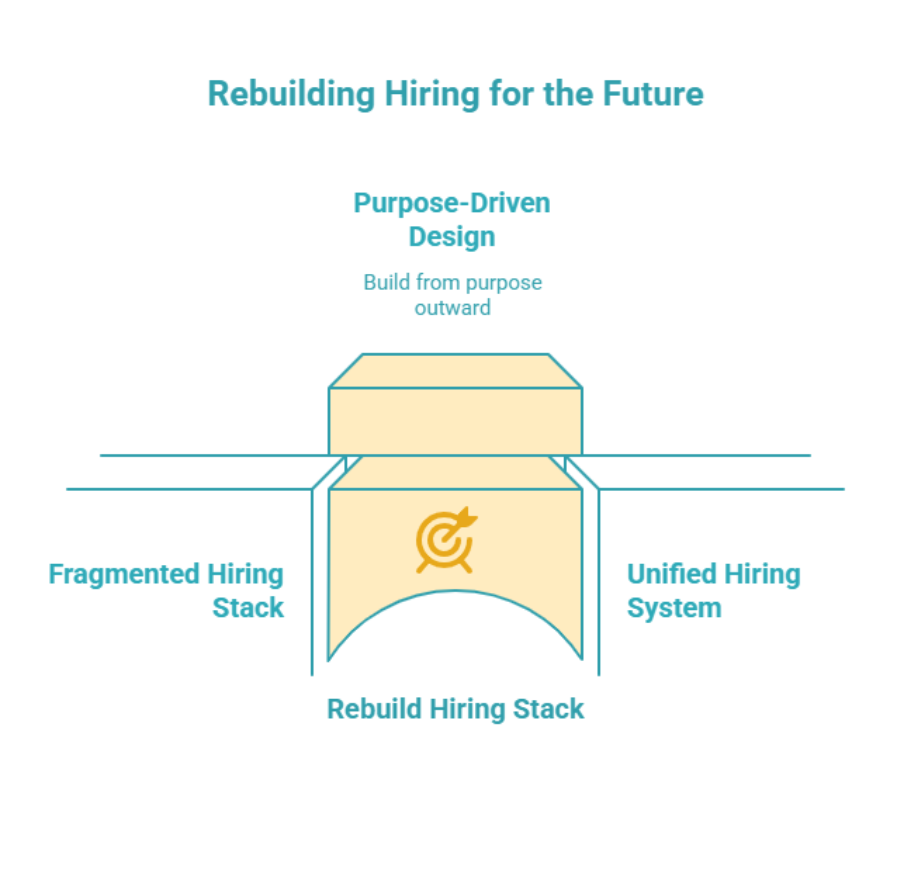
Every few decades, hiring rewrites its own rules. Once it was newspaper ads and walk-ins. Then came databases and job boards. Then algorithms and video interviews. Each shift promised efficiency, but what we have today is a patchwork. Applicant Tracking Systems connect poorly to assessment tools, learning portals link only partially to payroll, and AI features feel bolted on like aftermarket parts. It works, mostly. Until it does not.
The truth is, the modern hiring stack is a Frankenstein of every technological era we have passed through. Each layer was built on the assumptions of the one before it. What forward-thinking companies are doing now is not just adopting new tools. They are dismantling and rebuilding the architecture itself.
By 2030, the hiring stack will not be a software product. It will be an intelligent ecosystem, a living, learning infrastructure that connects skills, credentials, performance data, and human context into one coherent flow. Companies that start building that architecture now will lead. Those that wait will spend the next decade cleaning up after themselves.
From Paper to Predictive: A Brief History of How We Got Here
Hiring’s story mirrors the history of information systems. Before 1950, it was all paper: résumés in filing cabinets, referrals over lunch, ads in newspapers. It worked because scale was small. You could know your candidates by name.
Then the mainframes came. Payroll and personnel systems went digital. In the 1990s, the Applicant Tracking System (ATS) emerged as a searchable résumé vault with keyword filters that became both savior and curse. Recruiters gained speed, but lost nuance. A typo in a keyword could erase a person.
Through the 2000s, job boards and LinkedIn democratized visibility, yet flooded recruiters with noise. Staffing firms expanded, contingent work surged, and “talent” became a managed commodity. By the 2010s, AI promised to fix the noise problem through ranking, parsing, and predicting. Instead, it exposed new ones: bias, opacity, and broken trust.
The stack we inherited from that journey is fragmented and reactive, shaped more by technological possibility than by human design. The 2030 hiring stack is a chance to reverse that: to rebuild from purpose outward, not tools inward.
Read more: Agentic AI in Recruiting: The Future of Recruitment Intelligence
The Core Pillars of the 2030 Hiring Stack
The Skills Canonicalization Layer
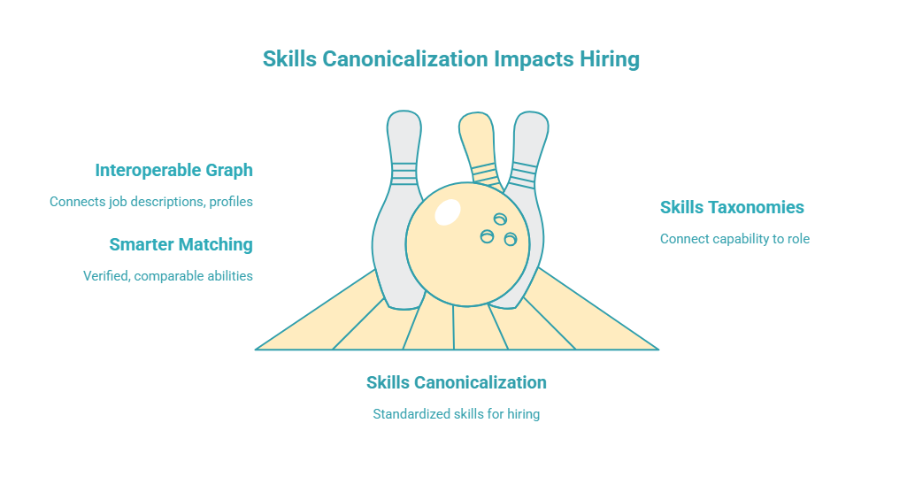
Every great system starts with a shared language. For hiring, that means skills. Not vague buzzwords, but canonical, standardized skills mapped to globally recognized IDs. Think of it as the “DNA” layer of the hiring stack: connecting job descriptions, candidate profiles, learning systems, and performance reviews into one interoperable graph.
Today, job titles are proxies and degrees are shortcuts. A 2024 Harvard Business School and Burning Glass Institute study of more than 11,300 roles found that simply removing degree requirements increased non-degreed hires by only about 3.5% on average. Only the minority of employers that also redesigned assessments, job descriptions, and data flows saw meaningful diversification, achieving gains of nearly 20% more non-degreed hires and around 10 percentage points higher retention for those hires.
That is why leaders are building internal “SkillGraphs”, dynamic maps of what capabilities exist, what are emerging, and where to source or grow them. A mature skills layer makes every other part of the stack smarter, matching candidates not by résumé keywords, but by verified, comparable abilities.
Assessment and Credential Engine
Degrees are fading as trust proxies. What replaces them is evidence: adaptive assessments, micro-credentials, portfolios, and live skill demonstrations.
Next-gen stacks will merge assessment data with credential registries, allowing recruiters to verify skill claims instantly. Blockchain-based systems already operating in South Asia, such as TruScholar in India and ShikkhaChain in Bangladesh, demonstrate how this works. A candidate’s credential is no longer a PDF but a verifiable data object.
For employers, that means less fraud and faster verification. For candidates, it means portability: proof of competence that travels between platforms and borders.
Assessments will evolve from filtering tools to learning moments, brief, role-relevant simulations that adapt in difficulty and provide feedback. Instead of gatekeeping, the system becomes developmental.
AI Screening and Explainability Module
AI is no longer an add-on. It is the stack’s brain, but an accountable one.
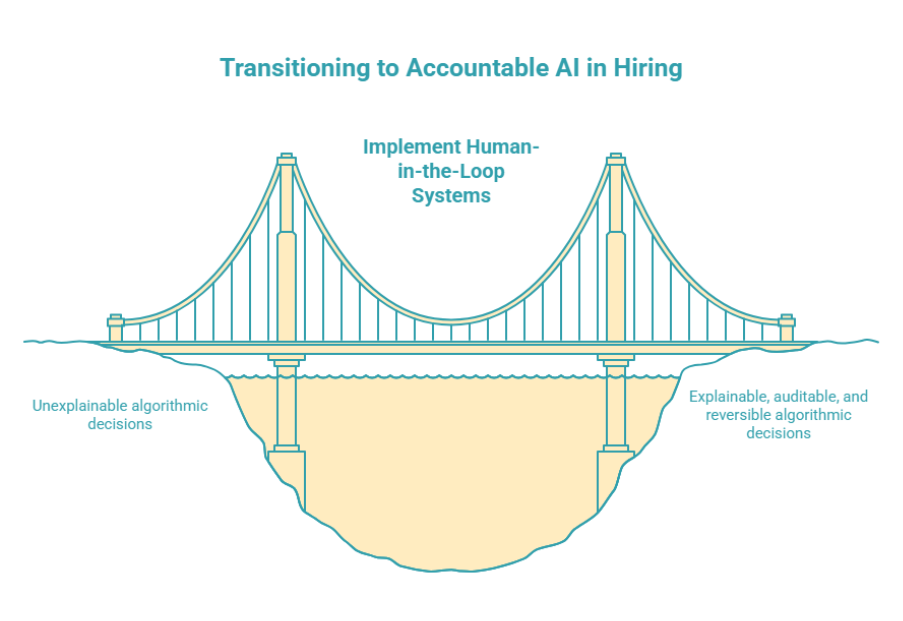
In 2030’s architecture, every algorithmic decision must be explainable, auditable, and reversible. Quiet black boxes that score candidates with undisclosed logic no longer pass scrutiny.
Forward-thinking firms are building human-in-the-loop pipelines. Algorithms propose, humans approve. Every ranking or rejection can be traced, showing inputs, weights, and fairness metrics.
Auditable AI hiring reports are already becoming legal expectations in major jurisdictions. Companies that bake transparency and appeal mechanisms into their systems now will be far ahead when regulations fully enforce.
Talent Orchestration and Internal Marketplaces
The hiring stack of 2030 is not just about new people. It is about fluid talent movement inside and outside the organization.
Modern enterprises are building internal marketplaces that match employees to projects, gigs, and learning paths using the same intelligence once reserved for external recruiting.
This is the end of siloed HR. Instead of Talent Acquisition, Talent Management, and L&D operating separately, everything feeds a unified orchestration layer. Contractors, freelancers, fractional executives, and employees coexist in a shared talent pool with common rules for pay, compliance, and growth.
It is a move from “filling seats” to allocating capability, the workforce as a dynamic organism.
Learning and Reskilling Integration
Hiring no longer ends with an offer letter. The best companies see learning as the second half of hiring.
McKinsey’s latest workforce forecasts estimate that by 2030, up to 375 million workers globally may need to switch occupations. They also project that demand for many core skill categories in advanced economies will shift significantly, with some growing or shrinking by 20% to 50%. That means every hiring decision should trigger a learning pathway, not an end point.
Forward-thinking organizations are integrating Learning Management Systems directly into their hiring stack:
- Predicting future skill gaps.
- Tagging new hires with personalized learning tracks.
- Measuring ROI in retention and promotion rates.
It is the closed loop between workforce planning, hiring, and upskilling that defines a truly intelligent stack.
Compliance, Privacy and Rights Layer
By 2030, every hiring system will need a compliance engine as sophisticated as its AI.
The new regulatory reality, from New York City’s algorithmic audit laws to the EU AI Act, demands transparent consent, bias monitoring, and data retention governance.
Modern stacks embed:
- Automated consent flows.
- Candidate rights dashboards (“see my data,” “appeal my result”).
- Bias impact calculators built into every stage.
Hiring will become a regulated data practice, not an ungoverned business function. Compliance will not slow hiring. It will enable trust, the most valuable currency in an era of algorithmic decisions.
Environmental Sustainability Layer
One of the most overlooked frontiers in hiring tech is its carbon footprint.
Industry and academic audits show that recruiting-related travel and cloud compute can account for a large share of a company’s per-hire emissions, often more than half. The next generation of stacks will calculate CO₂e per hire the same way finance teams calculate cost per hire.
Virtual recruiting has already cut travel emissions dramatically, and some large-scale programs have eliminated hundreds of tons of CO₂e annually by shifting to virtual-first processes. The goal is carbon-intelligent recruitment, optimizing both talent and sustainability outcomes.
Fresh Insights: The 2025 Research That Is Rewiring the Field
Three recent papers are quietly reshaping how experts think about the next hiring era.
Invisible Filters (2025, arXiv)
This study compared how large language models scored identical candidate transcripts written in British versus Indian English. The results showed that even when anonymized, transcripts written in Indian English consistently received lower scores, often by the equivalent of around half a point on a five-point scale, due to lexical and stylistic bias.
Lesson: fairness is not just statistical. It is cultural. Future stacks will need locale-specific calibration to ensure global equity.
Two Tickets Are Better Than One (2025, arXiv)
Researchers found that when applicants use LLMs to enhance résumés, AI systems tend to reward the same manipulative patterns, such as overly polished phrasing and tidy formatting, creating “strategic unfairness.” Their solution is the two-ticket system: one human-authored version and one AI-assisted version, both analyzed for divergence.
Experiments showed this approach significantly reduced measured disparities in hiring outcomes between groups.
Lesson: algorithmic integrity must include adversarial awareness. Tomorrow’s stack will be built to expect manipulation, not merely detect it.
Mitigating Attrition (2025, arXiv)
Data scientists modeled retention prediction using integrated HR data. They found that hiring path data, for example AI-heavy versus human-led routes, emerged as one of the most important predictors of two-year retention in their models.
Lesson: hiring metrics can no longer stop at time-to-fill. The future is hire-to-thrill, linking sourcing methods directly to performance and longevity.
Together, these studies redefine fairness, resilience, and accountability for the hiring stack.
The Gaps, Trade-Offs and Risks We Still Have Not Solved
Candidate Overload and Assessment Fatigue
Large-scale analyses of hundreds of thousands to millions of pre-hire assessments show completion rates drop sharply after 20 to 30 minutes or the second lengthy task. Over-testing filters not just unfit candidates but busy, underrepresented, or less digitally fluent ones.
By 2030, leading companies will treat candidate cognitive load as a design metric. They will run A/B experiments to find the optimal number and length of assessments, balancing rigor with respect for time.
Signal vs Noise in the Age of AI Résumés
Generative AI makes it effortless to craft perfect résumés and to fake them.
Recruiters now face a paradox: the better the text, the less you can trust it.
This is why the skills and credential layers matter. They anchor hiring to verifiable data, not surface polish.
Some organizations are piloting multi-signal verification, combining digital credential checks, live micro-tasks, and metadata forensics to confirm authenticity without invasive policing.
The Carbon Blind Spot
For all its talk of optimization, hiring still largely ignores its environmental cost.
From travel emissions to compute-intensive AI models, few companies have measured their per-hire footprint.
Those that do will not only reduce emissions but also unlock efficiency, cutting redundant interviews, storage, and wasteful processing.
Prestige Bias and the Homogenization Trap
Even with fairer algorithms, prestige bias lingers, especially outside the West.
Some audit and field experiments have found that identical résumés differing only by university prestige can receive substantially more callbacks in certain markets, particularly in highly competitive sectors. Other studies, however, find little or no effect once skills and experience are carefully matched.
If future hiring stacks rely too heavily on standardized credentials, they risk reproducing the same elite filters, only now at scale.
The antidote is contextualization. Weight performance data and demonstrated skill over institutional brand. The best stacks will learn from outcomes, not pedigrees.
Global Disparities in Stack Maturity
In emerging markets, the leapfrogging has already begun.
Bangladesh’s ShikkhaChain and India’s TruScholar projects show how blockchain-based credential systems can bypass legacy ATS entirely and dramatically reduce credential fraud, while improving inclusion.
Africa’s outsourcing sector is using mobile-first assessment and decentralized verification to extend access.
The lesson is simple. The 2030 stack will not look the same everywhere. It will adapt to infrastructure realities, with some regions skipping straight to innovations that richer markets are still debating.
Read more: ATS vs Agentic AI: What’s Changing and Why It Matters
Design Patterns and Best Practices Emerging from the Field
Here is what the most innovative teams are already prototyping.
- The Two-Ticket Résumé System: Require both a human-authored and AI-assisted résumé submission and analyze divergence to detect manipulation and improve fairness.
- Hire Path Tagging: Tag every new hire with the sourcing and assessment path, such as AI versus human or skill test versus referral. Over time, this enables longitudinal retention and performance analysis.
- Assessment Fatigue Dashboards: Visualize completion and dropout rates across demographics and stages. Use adaptive testing to shorten assessments where confidence is high.
- Cultural Calibration Protocols: Validate models across languages, accents, and communication styles. A model trained on Western English must be tuned before global deployment.
- Sustainability Dashboards: Add carbon per hire and compute energy per assessment to recruiting KPIs. This reframes efficiency as both economic and ecological.
- Trust Instrumentation: Embed candidate trust surveys and behavior signals such as drop-off, acceptance rates, and feedback directly in the ATS to monitor experience in real time.
These design patterns transform the stack from a transactional machine into a learning organism, one that self-audits and improves continuously.
Case Studies: Signals from the Future
Case 1
European enterprises such as Vodafone, which rebuilt parts of their talent systems around skills-based architectures and AI-driven matching, reported ~28% faster redeployment and an ~18% reduction in reliance on external hiring.Teams also saw stronger first-year retention among employees moved through internal mobility pathways versus external hires.The edge came from skills traceability—clearly seeing which skill pathways consistently produced long-term, high-performing talent.
Case 2
Indian employers using government-backed digital credential platforms such as DigiLocker—and verification layers from providers like OnGrid and NSDL—have sharply reduced document verification times, often by 70–80%. Recruiters report noticeable reductions in candidate drop-off because applicants no longer need to repeatedly upload identity or education documents. Trust improves when records are verified instantly and the process feels transparent.
Case 3
Fortune 500 organizations that shifted most final-round interviews to virtual formats as part of their post-2020 hiring redesign have cut a substantial portion of long-haul interview travel. Deloitte reported a 94% reduction in travel emissions, while Microsoft documented significant CO₂e savings from replacing in-person loops with remote formats. In some programs, these changes eliminate hundreds of tons of CO₂e annually.
Case 4
In Bangladesh and Southeast Asia, platforms like Pathao and Grab use mobile-first assessments tied to eKYC and digital ID verification APIs. Without legacy ATS constraints, these companies regularly onboard thousands of gig workers within 24–48 hours, with far lower rates of credential fraud compared to paper-based checks. The combination of mobile workflows and verified digital IDs makes high-volume onboarding both faster and safer.
For them, the future is not about catching up. It is about skipping ahead.
Measuring What Matters: KPIs for the 2030 Hiring Stack
What you measure shapes what you build.
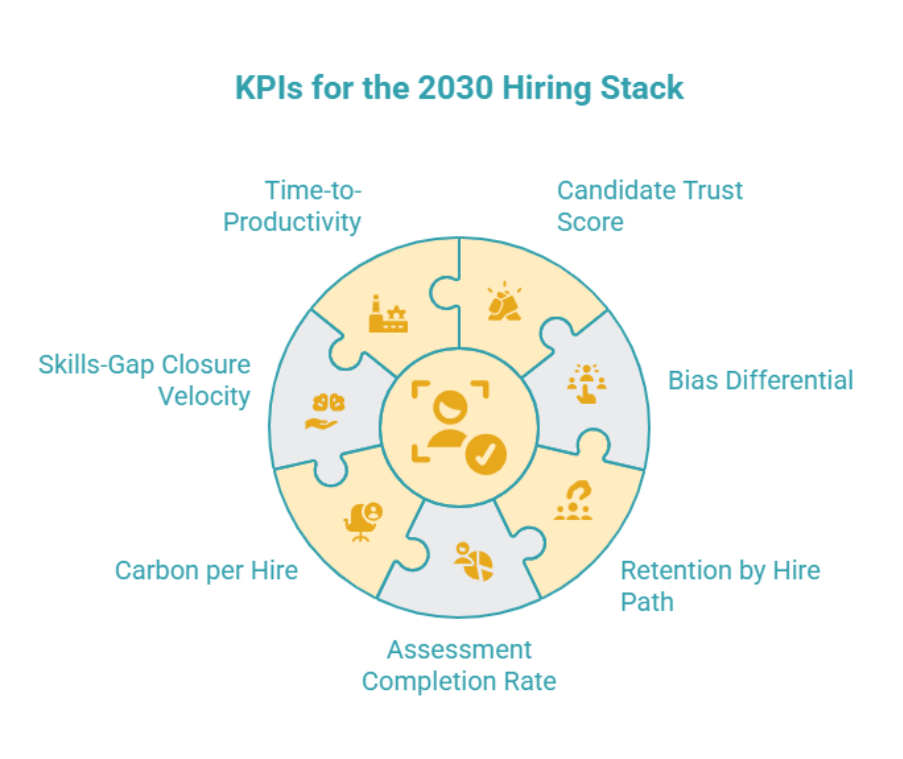
These are the metrics the next decade’s leaders will track:
- Candidate Trust Score: a composite of transparency, communication, fairness perception, and data-use consent.
- Bias Differential (TPR gap): difference in true positive rate across demographic groups at each stage.
- Retention by Hire Path: 6, 12, and 24 month retention rates segmented by sourcing and screening method.
- Assessment Completion Rate: with demographic breakdowns and fatigue indicators.
- Carbon per Hire (kg CO₂e): total lifecycle emissions from sourcing to onboarding.
- Skills-Gap Closure Velocity: how quickly the organization fills or trains for emerging skill gaps.
- Time-to-Productivity: how fast new hires reach defined performance benchmarks.
Metrics like these turn hiring into an evidence-based discipline, not a ritual. They bridge human judgment and system intelligence.
The Roadmap: How to Build the 2030 Stack
Stage 1: Pilot and Prove
Start small. Pick one or two design patterns to test, perhaps a trust survey or a carbon audit. Treat them as experiments with measurable baselines.
Stage 2: Integrate and Instrument
Connect data flows. Tag every hire with process metadata, integrate skill taxonomies, and unify internal and external candidate pools. Build dashboards that visualize fairness, fatigue, and carbon.
Stage 3: Govern and Scale
Establish ethics committees, bias review boards, and external audits. Codify transparency protocols, including how AI decisions are logged, explained, and made appealable.
Create cross-functional councils, bringing together HR, data science, compliance, and sustainability, to oversee the stack as shared infrastructure.
Stage 4: Evolve Continuously
The stack is never “done.” Every dataset, regulation, and cultural shift will demand recalibration. Companies that treat hiring tech as a living ecosystem, not a product, will adapt fastest.
Conclusion: Building Beyond Efficiency
By 2030, hiring will not be about filling roles. It will be about designing ecosystems of trust, transparency, and adaptability.
The companies that win will not be those with the fanciest AI. They will be the ones that understand what to automate and what to preserve as human.
They will measure fairness as carefully as cost, carbon as closely as time, and trust as rigorously as ROI.
The hiring stack of 2030 is not a prediction. It is a project already underway.
The question is simple: are you still patching tools together, or are you architecting the future of how people and work find each other?





Stop tracking hiring.
Start running it
We’re onboarding early teams ready to experience AI recruiting that’s faster, smarter, and easier to manage. No fees. No commitments. Just real usage and real feedback.


