


Recruiting for startups with AI: Scaling Without Headcount
Updated On:
February 20, 2026

Why This Topic Matters Now
Recruiting for startups has always been a paradox. You’ve raised your seed round. The product vision is no longer just a slide deck; it’s taking shape in code commits and prototypes. Investors want traction, and traction requires people. But here’s the issue, while your growth demands talent, your budget punishes headcount. Recruiters are expensive, agencies demand fees that rival your burn, and every resume pile feels like quicksand.
This is the hiring trap startups fall into—an urgent need for talent colliding with brutal constraints on resources. Scaling without breaking your runway seems impossible. Unless you stop thinking in terms of “more people” and start thinking in terms of “more leverage.”
That’s where AI enters—not as a flashy gadget, but as infrastructure. In startup recruiting, AI isn’t here to replace humans; it’s here to amplify what lean teams can achieve. It transforms a two-person operation into a hiring engine that can rival an entire corporate talent team. When done right, it doesn’t remove the human element — it empowers it. By taking repetitive work off your plate, it gives your team the space to focus where human judgment truly matters.
The Startup Struggle: Hiring Breaks When You’re Small
Founders know the pain points too well.
- Resume avalanches. One open role, and suddenly 300 applications hit your inbox. Screening becomes a second job.
- Ghosting chaos. Candidates vanish mid-process, often because communication lags on your end.
- Recruiting overhead. Agencies charge twenty to thirty percent of salaries. Internal recruiters cost what your engineers cost.
For corporates, these inefficiencies are annoyances. For a lean team, they’re existential. Every missed hire is product delayed. Every poor hire is cultural drag. Every wasted week in scheduling is opportunity slipping away.
When recruiting for startups, every bad hire drains morale, and every delay slows product velocity. So how can a two-person team compete with enterprise hiring machines? They don’t out-hire—they out-automate.
From Sci-Fi to Workflow: AI Recruiting in Action
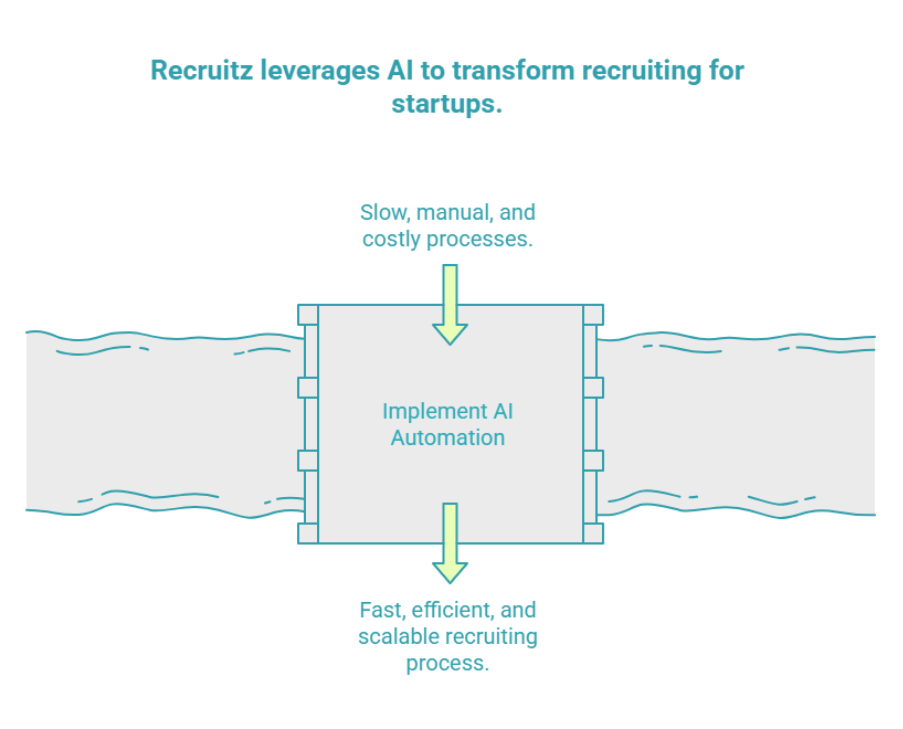
Real-world examples already exist at scale. Small agencies and startups using modern AI screening + conversational tools routinely report 85–92% reductions in manual screening time and 45–60% faster time-to-hire while managing 5–10× more requisitions per recruiter than traditional methods
For founders, this isn’t fantasy—it’s workflow. Instead of building HR infrastructure from scratch, they adopt AI recruiting startups tools that handle resume parsing, scheduling, and candidate follow-ups automatically. The result: a recruiting function that feels 10× bigger without a single new hire.
AI becomes the hustler teammate you always wanted: tireless, fast, and focused on the grunt work.

Why AI Is Built for Startups, Not Just Corporates
Corporates debate implementation for months; startups plug and play. This is why AI in HR tech fits the startup DNA so naturally. Lean companies are already used to moving fast and optimizing every process.
- Scrappy scaling. Small businesses are already budgeting for AI tools because they deliver leverage without overhead.
- Founder ethos. “Automate fast, hire slow” has become the unofficial playbook in incubators. Founders understand that every manual process they avoid now is a headache saved later.
- Competitive edge. While big firms argue about compliance documents, a startup can spin up a chatbot and start screening candidates the same week.
In other words, that’s what makes AI in HR tech a foundation, not a luxury.
What AI Actually Does Better
Let’s get specific. Modern AI screening tools outperform human recruiters in three ways—speed, fairness, and consistency.
Speed
Conversational bots and guided application flows eliminate friction. AI screening tools also reduce bias through structured, repeatable evaluation methods, helping startups find talent based on skills rather than pedigree. And because AI never forgets follow-ups or updates, candidate communication stays constant—building trust and improving offer acceptance rates.
Fairness
Despite the upside, AI bias in hiring remains a serious concern. Speech-to-text systems can misinterpret non-native accents, and biased datasets can skew results. Startups must stay vigilant.
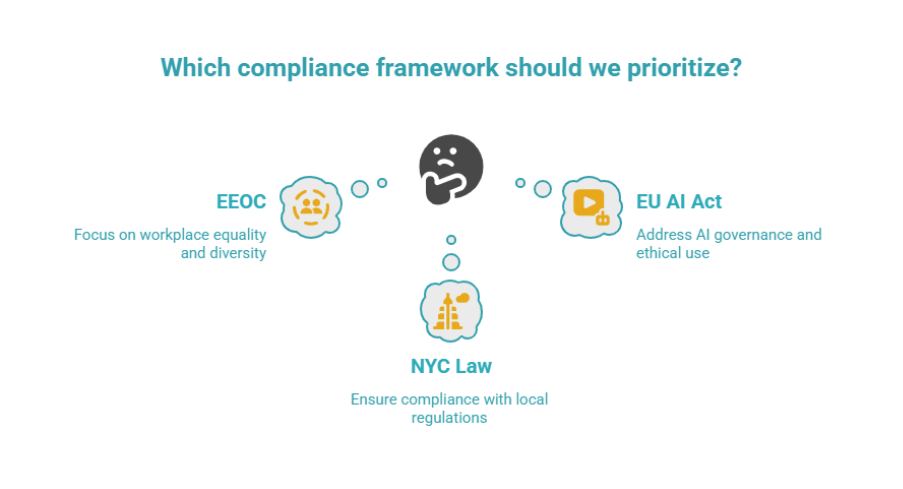
There are also emerging compliance risks. The U.S. EEOC and the EU AI Act classify recruiting AI as “high-risk,” demanding transparency and fairness audits. Implementing AI bias in hiring safeguards—like clear disclosures, fairness checks, and diverse training data—isn’t just ethical, it’s strategic brand protection.
Consistency
Candidates ghost when they feel ignored. 2025 data shows 52–68% of candidates drop out when they go more than 7 days without communication or personalized updates
AI doesn’t bring charisma, but it brings reliability. And for lean teams, reliability is priceless.
The Shadows You Can’t Ignore
Of course, no technology is free of pitfalls. AI recruiting has shadows every founder must acknowledge.
- Bias in accents. Speech-to-text models often stumble with non-native English speakers, penalizing talent unfairly. For global teams, this is a serious risk.
- Regulatory guardrails. In the U.S., the EEOC requires accommodations and bias audits. New York City mandates independent audits and candidate disclosures. The EU AI Act treats recruiting AI as “high-risk,” demanding transparency and human oversight.
- ROI traps. Many AI projects fail because teams chase tools without proving business value. Adoption without clarity leads to cost without return.
AI can be rocket fuel—or a rocket crash. The difference is steering.
Measuring Success: Efficiency, Not Headcount
Corporates measure recruiting by headcount added. Startups measure it by efficiency gained. Revenue per employee is the real north star.
Startups don’t measure recruiting success by headcount—they measure by efficiency. Using AI to automate recruitment process workflows cuts time-to-hire in half and reduces recruiter workload by up to 75%.
When startups automate recruitment process steps, their revenue per employee rises. Each team member delivers more value because systems carry the operational weight. In short: efficiency isn’t a luxury metric—it’s a survival strategy.
The Startup Playbook: 5 Moves to Scale Hiring with AI
So how do you actually execute? Think of it as a founder’s cheat sheet.
- Identify one pain point. Start with the bottleneck that hurts most—resume screening, interview scheduling, or candidate communication.
- Pilot small. Test AI on one role or one hiring round. Success scales; failure contains itself.
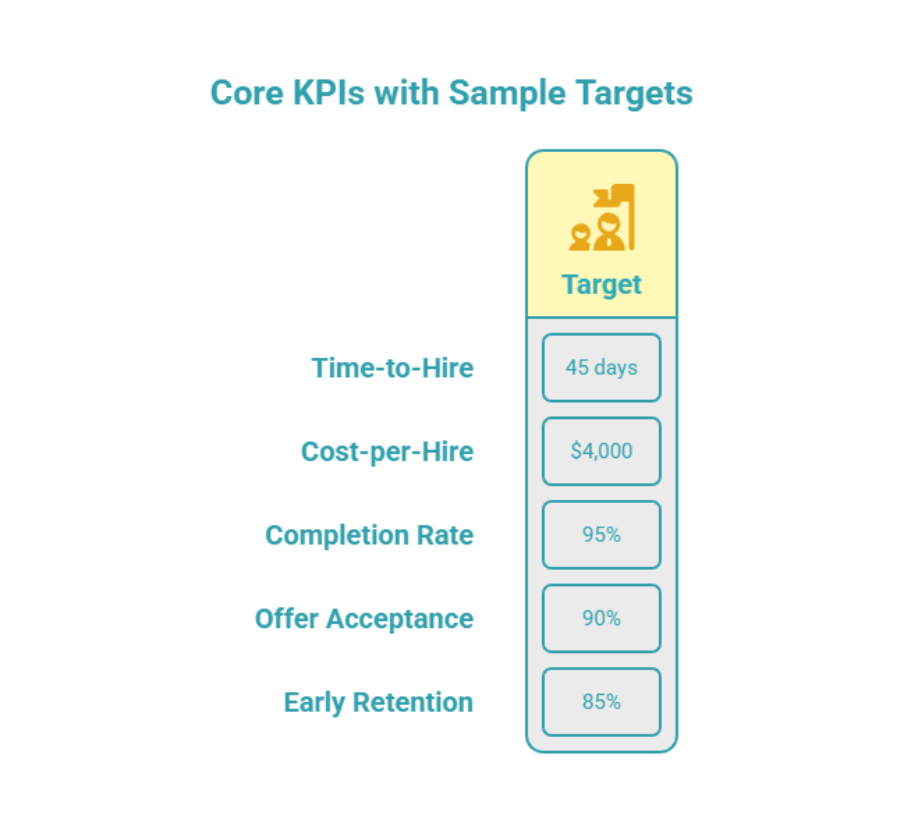
- Measure ruthlessly. Track time-to-hire, cost-per-hire, candidate satisfaction. If it’s not moving numbers, it’s noise.
- Audit fairness early. Run checks on pass-through rates. Avoid blind spots before they hurt your brand.
- Keep humans at the gates. AI should filter and organize. People should decide.
Scaling your AI in hiring process doesn’t require complex infrastructure. Start small: identify one pain point, pilot one AI tool, and measure results. Track time-to-hire, candidate satisfaction, and bias metrics.
The result: a repeatable process that feels like an extension of your founding team.
Building the Lean Recruiting Stack
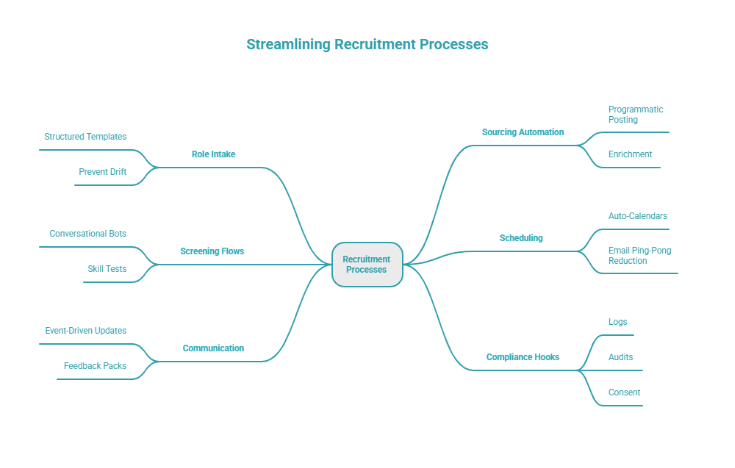
The tools don’t need to be complex. You need a lightweight architecture:
- Role intake. Structured templates that prevent drift.
- Sourcing automation. Programmatic posting and enrichment.
- Screening flows. Conversational bots and skill tests that standardize early signals.
- Scheduling. Auto-calendars that kill email ping-pong.
- Communication. Event-driven updates and feedback packs.
- Compliance hooks. Logs, audits, and consent baked in.
The goal isn’t to automate everything. It’s to make the routine invisible so judgment stands out.
Candidate Experience at Startup Speed
A lean team can still deliver an exceptional candidate journey using AI in hiring process automation. Automated updates, transparent feedback, and quick responses make candidates feel valued even before they join.
Startups that respect applicants’ time build reputations faster. Many candidates use AI tools themselves, so when your AI in hiring process feels modern and responsive, it reinforces your brand as progressive and efficient.
In the war for talent, reputation matters. A respectful experience today is the referral pipeline tomorrow.
Industry Playbooks: AI Recruiting Across Verticals
SaaS
Rank candidates on problem-solving skills and code samples. Reserve human interviews for system design and product judgment.
E-commerce
High-volume screening, shift scheduling, and attendance prediction make AI a game-changer.
Fintech
Focus on compliance-heavy workflows. Use AI to document, log, and track audit requirements.
Healthtech
Verify certifications through structured checks. Use scenario-based questions to measure decision-making.
Each industry uses AI in HR tech differently. SaaS startups use code-based evaluations; e-commerce leverages shift prediction; fintech automates compliance logs; and healthtech validates certifications.
No matter the vertical, the rule stays constant: AI in HR tech automates the predictable so humans can focus on creativity and culture.
The Economics: Making the Math Work
The numbers speak volumes. Realistic 2025 benchmarks show AI recruiting platforms deliver 50–70% reductions in time-to-hire and 60–80% lower cost-per-hire for startups and small teams when screening and scheduling are fully automated.
Founders should model cost-per-hire with and without AI. Factor in opportunity cost of founder hours. Add retention and early performance metrics. If the numbers don’t improve, either the tool is wrong or the process is misaligned.
Trust, Risk, and Bias
Efficiency doesn’t excuse negligence. AI bias in hiring can quietly undermine trust if left unchecked. Startups must test rigorously: diverse data sets, interpretable features, stability checks across resume formats. Publish notices explaining where automation is used. Offer real accommodation paths.
Transparency is not optional; it’s brand equity. Candidates talk. A single story about biased or opaque hiring can haunt a startup longer than a missed sprint.
The Road Ahead: From Tools to Teammates
Next-gen AI recruiting startups are already evolving into agentic systems—handling sourcing, screening, and scheduling end-to-end. Humans will still make final calls, but the coordination will be autonomous.
This shift aligns with broader startup culture. Headcounts are shrinking while valuations climb. The next great recruiter might not be a person. It might be an AI agent—scalable, tireless, and equity-free.
FAQs
Q1: How can startups use AI to scale recruiting without increasing headcount?
By automating repetitive hiring workflows, AI recruiting startups enable lean teams to handle larger candidate volumes efficiently.
Q2: What are the best AI screening tools for early-stage startups?
Tools like Paradox, HireVue, and Humanly are leading AI screening tools that automate interviews and evaluations.
Q3: Does AI help reduce bias in the hiring process for startups?
Yes—structured evaluation through AI bias in hiring tools minimizes human bias and ensures fairer candidate assessment.
Q4: How can startups automate their recruitment process effectively?
Start by mapping manual bottlenecks and using AI to automate recruitment process steps like screening and scheduling.
Q5: What are the key risks of using AI in hiring and how can startups manage them?
The main challenge is AI bias in hiring, which can be managed through data audits, transparency, and human oversight.
Closing Takeaway
Startups don’t win by hiring armies of recruiters. They win by hiring smarter, faster, and leaner. Using AI to automate process workflow isn’t a gimmick. It’s the growth hack that turns lean teams into scalable engines.
The founders who embrace AI aren’t just cutting costs. They’re rewriting the DNA of how companies scale. And in this race, those still chasing resumes manually will be left behind.





Stop tracking hiring.
Start running it
We’re onboarding early teams ready to experience AI recruiting that’s faster, smarter, and easier to manage. No fees. No commitments. Just real usage and real feedback.


