


Solving Hiring Chaos: Dynamic Pacing with AI Workforce Planning
Updated On:
February 20, 2026
The Paradox of Modern Hiring
Somewhere between an overstuffed ATS and an empty pipeline lies the truth about why hiring feels broken.
Recruiters are running faster than ever. More tools, more data, more dashboards. Yet they are still chasing ghosts. Roles stay open for months, then flood with unqualified applicants overnight. Teams swing between frantic over-hiring and sudden hiring freezes.
This is what chaos looks like when speed outpaces sense.
The problem is not a lack of data. Modern talent teams track time-to-hire, pipeline conversion, and source performance with precision. The problem is pacing. Very few teams know how to steer by their data.
This is where AI workforce planning fundamentally changes the equation. Instead of treating hiring as a static headcount exercise, AI workforce planning enables organizations to regulate hiring velocity dynamically, adjusting speed, capacity, and effort as real-world conditions shift.
This approach, often described as dynamic pacing, treats hiring as a living system rather than a fixed workflow. It continuously recalibrates recruiting tempo using internal metrics, external labor-market signals, and evolving business demand.
1. Decoding Dynamic Pacing in AI Workforce Planning
Dynamic pacing is the operational engine behind modern AI workforce planning.
Rather than deciding upfront how many roles to open and how fast to fill them, AI-powered systems adjust hiring speed in real time. This represents the next evolution of AI recruitment tools and predictive hiring.
Dynamic pacing listens to three categories of signals:
Internal funnel health
Application volume, interview throughput, offer acceptance, and recruiter capacity.
External market pressure
Labor-market tightness from sources such as JOLTS data or LinkedIn Economic Graph insights.
Business demand signals
Product launches, revenue forecasts, delivery deadlines, and budget cycles.
As these inputs fluctuate, AI workforce planning systems recalibrate. They may throttle sourcing, redistribute recruiter time, slow interview velocity, or pause requisitions entirely.
The objective is not speed for its own sake, but alignment.
2. How We Got Here: A Short History of Hiring Chaos
Hiring chaos did not appear overnight. It is the result of decades of efficiency-driven optimization without system-level rhythm.
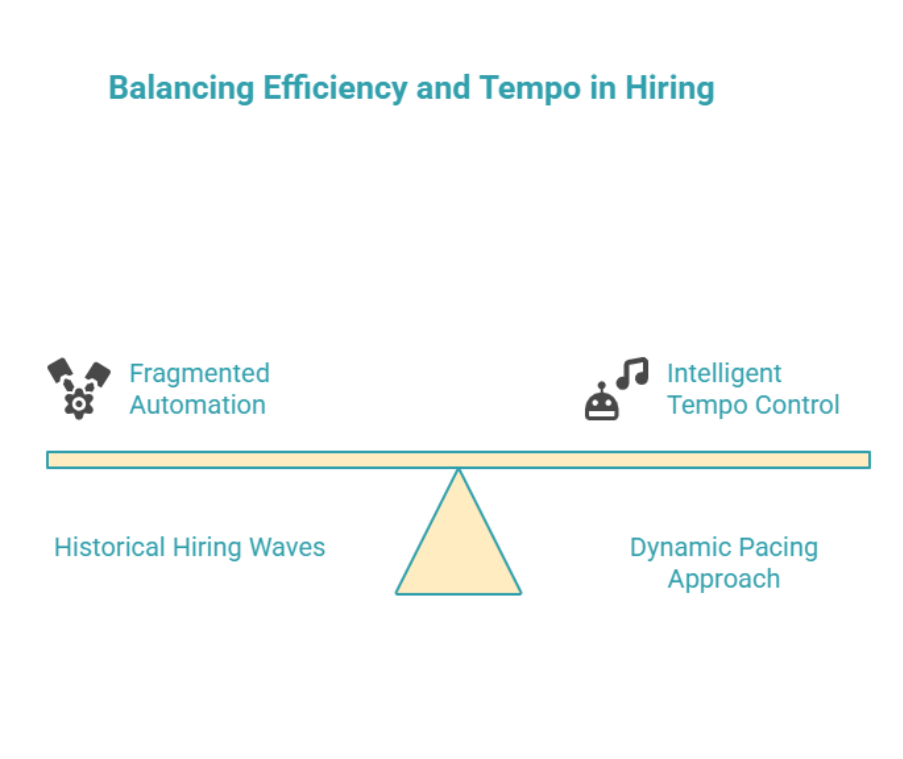
Scientific management turned labor into measurable units. Staffing firms normalized variable capacity. ATS platforms digitized resumes but introduced silos and delays. In the 2020s, AI accelerated tasks but fragmented workflows further.
Each wave optimized a part of the process while ignoring flow. The result was synchronized inefficiency.
AI workforce planning emerges as the counter-movement, shifting focus from raw throughput to controlled, adaptive tempo.
3. Anatomy of Hiring Chaos
Hiring chaos mirrors the behavior of complex systems.
Feedback delays cause teams to act on outdated demand signals.
Pipeline bottlenecks push pressure onto interview capacity rather than sourcing.
Source saturation amplifies bias and diminishing returns.
These forces create oscillations: hiring surges followed by freezes, urgency followed by paralysis. AI workforce planning closes the loop between observation and action by introducing pacing intelligence.
4. Principles of Dynamic Pacing in AI Workforce Planning
Dynamic pacing borrows from control theory and AI decision intelligence, following a continuous cycle: sense, decide, act, and learn.
AI workforce planning systems optimize for three objectives:
- Stability: keeping hiring close to target without oscillation
- Efficiency: minimizing time and cost without eroding quality
- Fairness: monitoring parity across pipeline stages
This requires predictive models for conversion and time-to-hire, optimization layers for resource allocation, and explainable AI so recruiters understand why pacing shifts occur.
5. Signals That Power AI Workforce Planning
Effective AI workforce planning depends on signal quality, not signal volume.
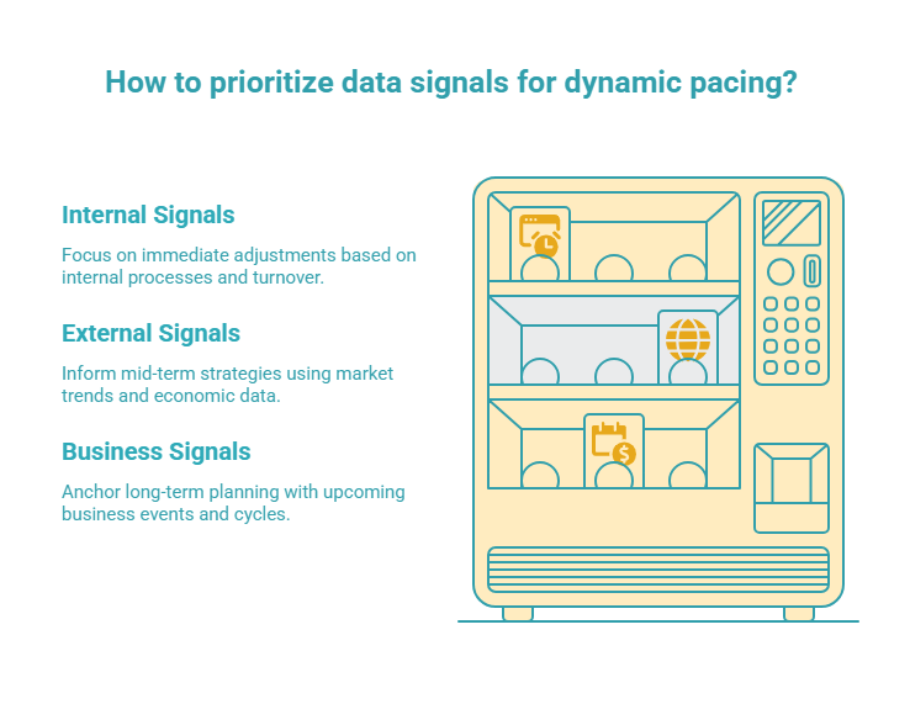
Internal signals include ATS timestamps, interviewer utilization, offer acceptance, and early turnover.
External signals include labor-market tightness, hiring velocity, and skill demand trends.
Business signals include product roadmaps, fiscal cycles, and forecasted demand.
Internal data drives short-term pacing decisions. External signals inform mid-term adjustments. Business forecasts anchor long-term planning. This is workforce analytics applied in real time.
6. The Speed–Quality Dilemma
Hiring fast works when the roles are repeatable and high-volume. It breaks down when the role is complex, senior, or hard to replace.
When every position is forced through the same timeline, quality suffers. Candidates drop out, interviews become rushed, and decisions are made with incomplete context.
AI workforce planning helps teams step out of this trap by recognizing that not every role should move at the same pace. High-volume roles can move quickly without damage. Strategic roles benefit from more time, better calibration, and deeper evaluation.
The goal is not to slow hiring down. It is to match the pace of hiring to the risk of getting it wrong.
7. Ethics and Fairness: Guardrails That Matter
Speed amplifies whatever is already in the system, including bias.
When hiring accelerates without oversight, small imbalances in sourcing or screening can quickly scale into unfair outcomes. This is especially true when algorithms influence who gets seen first or moved forward.
Responsible AI workforce planning builds checks into the process. It monitors who advances at each stage, flags patterns that drift over time, and ensures decisions can be explained, not just executed.
Fair hiring does not happen automatically. It requires intentional design and continuous attention. Without that, speed becomes a liability rather than an advantage.
8. The Human Equation: Recruiter Psychology
Recruiters are not unlimited resources.
When workloads spike, judgment suffers. Interviews blur together. Decisions get delayed or rushed. Burnout quietly reshapes outcomes long before performance metrics catch up.
AI workforce planning should support recruiters, not squeeze them harder. That means respecting realistic interview loads, rotating responsibilities, and allowing time to think, not just process.
Data-driven recruitment only works when the people interpreting the data are clear-headed and supported. If the system ignores human limits, the data becomes noise.
9. Internal Mobility: The Hidden Lever
Many hiring problems look external but start inside the organization.
Teams rush to source externally while overlooking employees who are ready to grow, move, or reskill. This lengthens hiring cycles, raises costs, and erodes engagement.
AI workforce planning can surface internal options early by factoring in skills, readiness, and upcoming transitions before opening new requisitions. This shortens time-to-fill and keeps knowledge inside the company.
Internal mobility is not just a talent benefit. It is one of the most reliable ways to stabilize hiring.
10. Beyond Tech: Sectoral Lessons
Hiring does not operate in a vacuum.
Healthcare hiring must account for licensing and credentialing delays. Manufacturing faces seasonal demand swings. Public-sector hiring is shaped by regulation and fixed posting windows.
AI workforce planning works when it adapts to these realities instead of forcing a single model everywhere. The pace of hiring should reflect the constraints of the role, the industry, and the environment.
Context matters more than tools.
11. Environmental and Cost Realities
Hiring decisions carry real costs, financial and environmental.
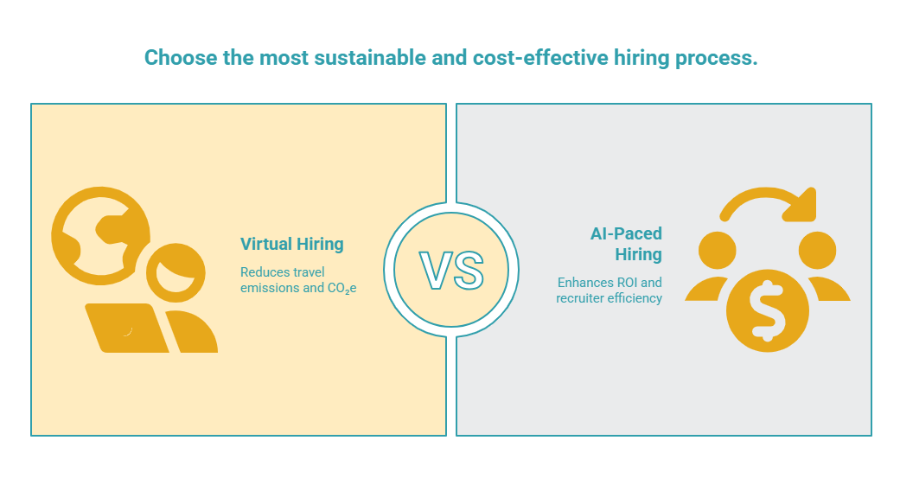
Virtual interviews reduce travel and scheduling friction. Better pacing reduces vacancy costs and unnecessary recruiter effort. Fewer rushed hires mean fewer replacements later.
AI workforce planning helps organizations use resources more carefully. Not by cutting corners, but by avoiding waste.
Smarter pacing leads to leaner operations and more sustainable hiring over time.
12. The Hiring Chaos Index
Most hiring teams know when things feel off, but they struggle to explain why.
The Hiring Chaos Index is simply a way to make that feeling visible. It looks at three signals most teams already track: how inconsistent time-to-hire is across roles, how many candidates drop out mid-process, and how long it takes to respond to candidates.
When these numbers start drifting in the wrong direction, it’s usually a sign that hiring is becoming reactive. Managers rush. Candidates disengage. Recruiters scramble.
A rising HCI doesn’t mean something has broken yet. It means pressure is building. Used correctly, it gives teams a chance to adjust hiring pace early instead of reacting after chaos hits.
13. Implementing AI Workforce Planning: A Practical Roadmap
AI workforce planning doesn’t start with models. It starts with clarity.
First, teams need to understand their own data. Where do delays happen? Which stages lose candidates? Which roles consistently go off track?
Next comes experimentation. Rather than overhauling everything at once, teams can pilot pacing changes on a small set of roles and compare results against business-as-usual hiring.
Only after that does scale make sense. Governance, recruiter judgment, and clear ownership matter as much as technology.
The goal is not faster hiring at all costs. It’s steady, predictable progress that balances speed, quality, and fairness.
14. Risks and Mitigations
AI workforce planning doesn’t remove risk. It changes where risk shows up.
Market conditions shift. Candidate behavior changes. Internal processes drift over time. Without attention, even well-designed systems lose accuracy and trust.
That’s why oversight matters. Teams need regular check-ins on outcomes, not just dashboards. They need to watch for fatigue, fairness gaps, and signs that candidates feel confused or ignored.
Transparency builds confidence. When people understand why hiring slows down or speeds up, the system feels supportive instead of imposed.
15. The Future: From Control to Collaboration
The future of AI workforce planning isn’t about tighter control. It’s about better coordination.
Hiring will increasingly adjust itself around real constraints: recruiter availability, candidate schedules, interview capacity, and market shifts. Instead of forcing pace, systems will recommend it.
Recruiters won’t compete with automation. They’ll guide it. Their role shifts from pushing requisitions through the system to deciding when and how the system should move.
The teams that win won’t eliminate chaos entirely. They’ll learn how to work with it, respond to it early, and keep hiring grounded even when conditions change.
Conclusion: Why AI Workforce Planning Defines the Future of Hiring
Hiring is not about moving faster. It is about moving at the right speed.
AI workforce planning replaces guesswork with governed rhythm. It transforms hiring from reactive scrambling into a controlled, adaptive system.
The future of hiring will not belong to the fastest teams.
It will belong to the teams that know how to pace themselves.
FAQs
What is AI workforce planning?
AI workforce planning uses predictive analytics and real-time data to align hiring pace with business demand and labor-market conditions.
How does AI workforce planning reduce hiring chaos?
It dynamically adjusts hiring speed based on pipeline health, recruiter capacity, and market signals, preventing over-hiring and freezes.
How does dynamic pacing work in AI workforce planning?
Dynamic pacing continuously recalibrates hiring velocity using internal recruiting data, external labor trends, and business forecasts.
Can AI workforce planning improve hiring efficiency?
Yes. It improves hiring efficiency by pacing roles differently, accelerating high-volume hiring while slowing complex searches.
Does AI workforce planning reduce hiring bias?
When combined with fairness constraints, explainability, and regular AI bias audits, AI workforce planning can reduce systemic hiring bias.
What data is required for AI workforce planning?
It relies on ATS data, workforce analytics, labor-market insights, and business demand forecasts.





Stop tracking hiring.
Start running it
We’re onboarding early teams ready to experience AI recruiting that’s faster, smarter, and easier to manage. No fees. No commitments. Just real usage and real feedback.


