


Beyond Automation: What Recruiters Actually Need in the Future of Work
Updated On:
February 20, 2026
When Recruiting Optimised Everything Except People
Somewhere between dashboards and deadlines, recruiting quietly lost its center of gravity.
What began as a people-first craft has evolved into an endless choreography of tools: automated scheduling, AI sourcing, algorithmic scoring, predictive dashboards. Efficiency has undeniably improved. Time-to-hire is shorter, pipelines are fuller, and workflows are faster. Yet as we move deeper into 2025, a heavier question lingers beneath the surface: what did recruiting lose while speeding up?
This tension sits at the heart of the future of work.
Recruiters today operate at a strange crossroads. They are expected to think like data analysts, communicate like brand storytellers, and respond like emotional anchors for candidates navigating uncertainty, all while managing technology stacks that evolve faster than job descriptions themselves.
Automation promised simplicity. Instead, it surfaced deeper challenges: misaligned hires, eroded trust, inclusion gaps, disengaged onboarding experiences, and rising attrition. Deloitte’s Human Capital research consistently highlights the growing tension between digital efficiency and human judgment. McKinsey’s work reinforces this view, suggesting that AI reallocates tasks rather than fully replacing roles, forcing recruiters to evolve rather than disappear.
So beyond automation, what do recruiters actually need in 2025?
Not another dashboard. Not another chatbot.
What they need is readiness: the mindset, literacy, and frameworks to humanize technology, translate data into judgment, and design hiring systems that still feel human within the future of work.
Hybrid Work Preferences & Adaptive Tool Design
The geography of hiring has been permanently reshaped.
Multiple global studies indicate that a clear majority of employees now prefer hybrid or flexible work arrangements. This shift has given rise to hybrid recruitment, a hiring model designed for distributed teams, asynchronous collaboration, and location-agnostic talent.
Yet many recruitment systems remain anchored to pre-pandemic assumptions: office-first workflows, rigid interview schedules, and synchronous availability expectations. This disconnect creates friction early in the hiring journey.
Hybrid recruitment requires adaptive tools. Scheduling platforms must respect time zones, assessments must function asynchronously, and analytics must capture engagement across digital and physical environments. In this model, how work happens becomes just as important as what work is done.
The Hybrid Expectation Gap
Deloitte research suggests that organizations offering hybrid flexibility often experience lower voluntary attrition compared to rigid, office-centric models. Flexibility has shifted from being a perk to a signal of trust and autonomy.
Recruiters practicing hybrid recruitment must therefore assess more than technical fit. They must evaluate how candidates collaborate remotely, manage autonomy, and communicate in distributed teams.
The Hybrid Fit Score
The Hybrid Fit Score reframes evaluation. It considers adaptability, digital collaboration, and self-direction using asynchronous simulations, collaboration tools, and preference alignment. The goal is not exclusion but alignment, matching people with environments where they are most likely to succeed.

Deep Inclusion: Neurodiversity & Cultural/Linguistic Sensitivity
Inclusion has moved beyond representation. In 2025, inclusive hiring practices are defined by system design rather than intent.
Neurodiversity has become a mainstream expectation. Candidates increasingly seek hiring processes that respect cognitive differences, sensory needs, and communication styles. Recent academic reviews and practitioner research suggest that recruitment outcomes for neurodivergent candidates are often shaped more by assessment design than by capability.
Inclusive hiring practices require recruiters to examine the tools themselves. Automated assessments frequently misinterpret pauses, phrasing, or tone. Linguistic bias compounds the issue. Research from global universities has shown that speech recognition and transcription systems perform less accurately for non-Western accents, creating real disadvantages in automated screening.
Inclusion Beyond Optics
Global hiring introduces cultural nuance. Communication norms, definitions of professionalism, and behavioral signals vary across regions. Tools trained primarily on Western datasets often struggle to interpret this diversity accurately.
Recruiters in the future of work must act as translators between global systems and local realities.
Inclusion Intelligence Mapping (IIM)
Inclusion Intelligence Mapping operationalizes inclusive hiring practices across the funnel:
- Input Layer: Clear, localized, bias-aware job descriptions
- Processing Layer: AI tools validated for linguistic and neurodiverse fairness
- Output Layer: Transparent feedback and appeal mechanisms
Organizations that embed IIM frameworks often see improved offer acceptance, stronger employer credibility, and reduced risk exposure.
Psychological Safety & Onboarding in Automated and Hybrid Recruiting
Automation has accelerated onboarding. It has not necessarily improved kindness.
Candidates frequently describe automated hiring as efficient yet emotionally distant, directly impacting the candidate experience in recruitment, especially during early onboarding.
Psychological research and practitioner studies indicate that candidates often perceive algorithmic interviews and automated onboarding as less fair, even when outcomes are positive. The missing ingredient is psychological safety, the sense that someone is paying attention beyond metrics.
From Efficiency to Empathy
The first 90 days define trust, productivity, and retention. When onboarding relies solely on automation, mass emails, and chatbots, it can unintentionally signal that relationships are secondary.
Recruiters influence the candidate experience in recruitment well beyond offer acceptance.

Onboarding Sentiment Score (OSS)
The Onboarding Sentiment Score combines AI-based sentiment analysis with human check-ins and peer feedback. It tracks confidence, clarity, and belonging during early integration.
OSS functions as an early warning system. Declines in sentiment often precede disengagement or exit, allowing recruiters to intervene before attrition occurs.
Role and Seniority Segmentation & Career Path Visibility
Hiring is not monolithic, yet automation often treats it that way.
What a startup needs from an entry-level hire differs significantly from what an enterprise seeks in a senior leader. Data-driven recruitment becomes valuable only when it restores this context.
Research from McKinsey suggests that generative AI can automate a significant portion of repetitive recruiting tasks. The real opportunity lies in how recruiters reinvest the time saved.
Career Path Transparency
Candidates increasingly want to understand where a role leads, not just what it pays. Workforce studies link visible progression pathways to higher acceptance and stronger retention.
Data-driven recruitment should illuminate trajectories, not just fill vacancies.
Career Trajectory Alignment Index (CTAI)
The CTAI evaluates alignment across:
- Skill adjacency and future readiness
- Motivational alignment between individual and organization
- Learning elasticity and reskilling capacity
When paired with internal mobility data, data-driven recruitment shifts from transactional hiring to long-term workforce planning.
ESG & Sustainability Mindset in Recruitment
Recruitment now carries reputational weight.
Sustainable recruitment reflects how responsibly organizations attract, assess, and integrate talent. It extends beyond environmental considerations to include equity, accessibility, and ethical data use.
In 2025, candidates increasingly evaluate employers through the lens of sustainability in recruitment, assessing whether hiring practices align with stated values.
Sustainable Recruitment in Practice
Travel-free interviews, paperless workflows, inclusive access, and transparent data practices are no longer optional. They signal integrity and accountability.
Sustainable Recruitment Score (SRS)
The SRS measures performance across three pillars:
- Environmental: Resource and energy efficiency
- Social: Accessibility, fairness, and inclusion
- Governance: Transparency, algorithm accountability, and vendor ethics
Recruiters fluent in sustainability in recruitment contribute directly to employer trust and brand equity.
The Future of AI in Recruitment: Beyond Screening
AI is no longer just a tool. It is a collaborator.
With scale comes risk. AI bias in hiring remains one of the most closely examined challenges in modern recruitment. Research on automation bias shows that human decision-makers may unconsciously defer to AI recommendations, even when skeptical of the system.
From Tools to Teammates
Addressing AI bias in hiring requires recruiter literacy. Prompt design, bias testing, model auditing, and override authority are now core capabilities rather than optional skills.
Augmented Recruitment Maturity Model (ARMM)
The ARMM outlines five stages:
- Ad-hoc automation
- Integrated workflows
- Human-in-the-loop assurance
- Collaborative intelligence
- Ethical orchestration
Recruiters operating at higher ARMM levels are not just efficient. They are trusted.
The Recruiter Readiness Index (RRI): Bringing It All Together
Across hybrid recruitment, inclusive hiring practices, data-driven recruitment, sustainability, and AI governance emerges a single question: how ready are we?
The Recruiter Readiness Index (RRI) integrates evolving recruiter skills into a measurable framework. These recruiter skills now include AI literacy, ethical judgment, inclusion design, sustainability awareness, and strategic advisory capability.
These are no longer optional. They define the skills for a recruiter operating effectively in the future of work.
The Human Equation: What Tech Still Can’t Replace
Technology predicts. Humans interpret.
Even the most advanced systems cannot replace judgment, context, and trust. The candidate experience in recruitment is ultimately shaped by how recruiters listen, respond, and decide.
A resume shows history. A model estimates probability. Only conversation reveals intent.
That translation remains deeply human.
The Future of Work and Recruiter Readiness
Taken together, these shifts reveal a defining truth about the future of work: recruiting is no longer about matching people to jobs, but aligning humans, systems, and values at scale.
Automation sets the pace. Readiness defines success.
Conclusion: The Recruiter’s Playbook for 2025
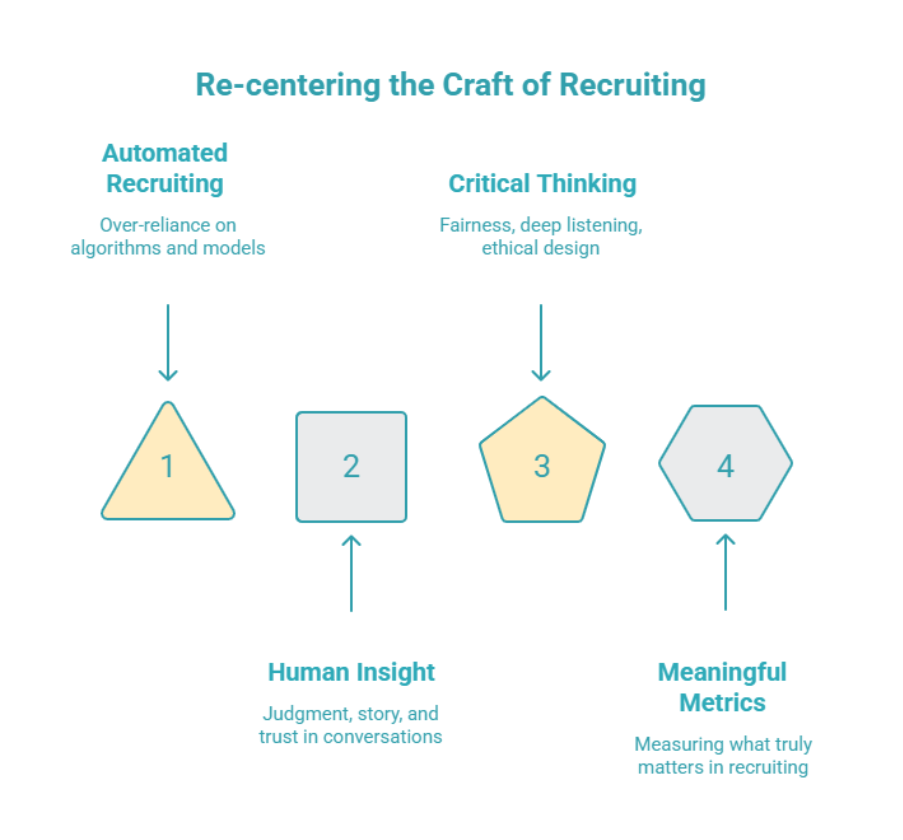
In the future of work, recruiters will not be measured by how quickly they automate, but by how thoughtfully they decide.
The playbook is clear:
- Apply hybrid recruitment to align people with environments
- Embed inclusive hiring practices into system design
- Protect candidate experience in recruitment through psychological safety
- Use data-driven recruitment to predict growth and retention
- Integrate sustainable recruitment into hiring operations
- Actively address AI bias in hiring through governance and literacy
- Continuously evolve recruiter skills through readiness frameworks
Beyond automation lies the real work: understanding people, designing fairness, and choosing with care.
Because in 2025, recruiting is not about filling roles.
It is about shaping the future of work.
FAQs
What does the future of work mean for recruiters in 2025?
It means balancing automation with human judgment while hiring for hybrid, inclusive, and technology-driven workplaces.
How is hybrid recruitment changing traditional hiring models?
Hybrid recruitment prioritizes flexibility, asynchronous collaboration, and distributed team readiness over office-first assumptions.
What recruiter skills are most valuable in the future of work?
AI literacy, bias awareness, data interpretation, ethical decision-making, and strong human communication.
How can data-driven recruitment improve hiring outcomes?
It improves consistency and retention by using analytics to assess role fit and long-term alignment.
Why are inclusive and sustainable hiring practices essential today?
They reduce bias, strengthen employer trust, and align recruitment with modern social and ESG expectations.





Stop tracking hiring.
Start running it
We’re onboarding early teams ready to experience AI recruiting that’s faster, smarter, and easier to manage. No fees. No commitments. Just real usage and real feedback.


